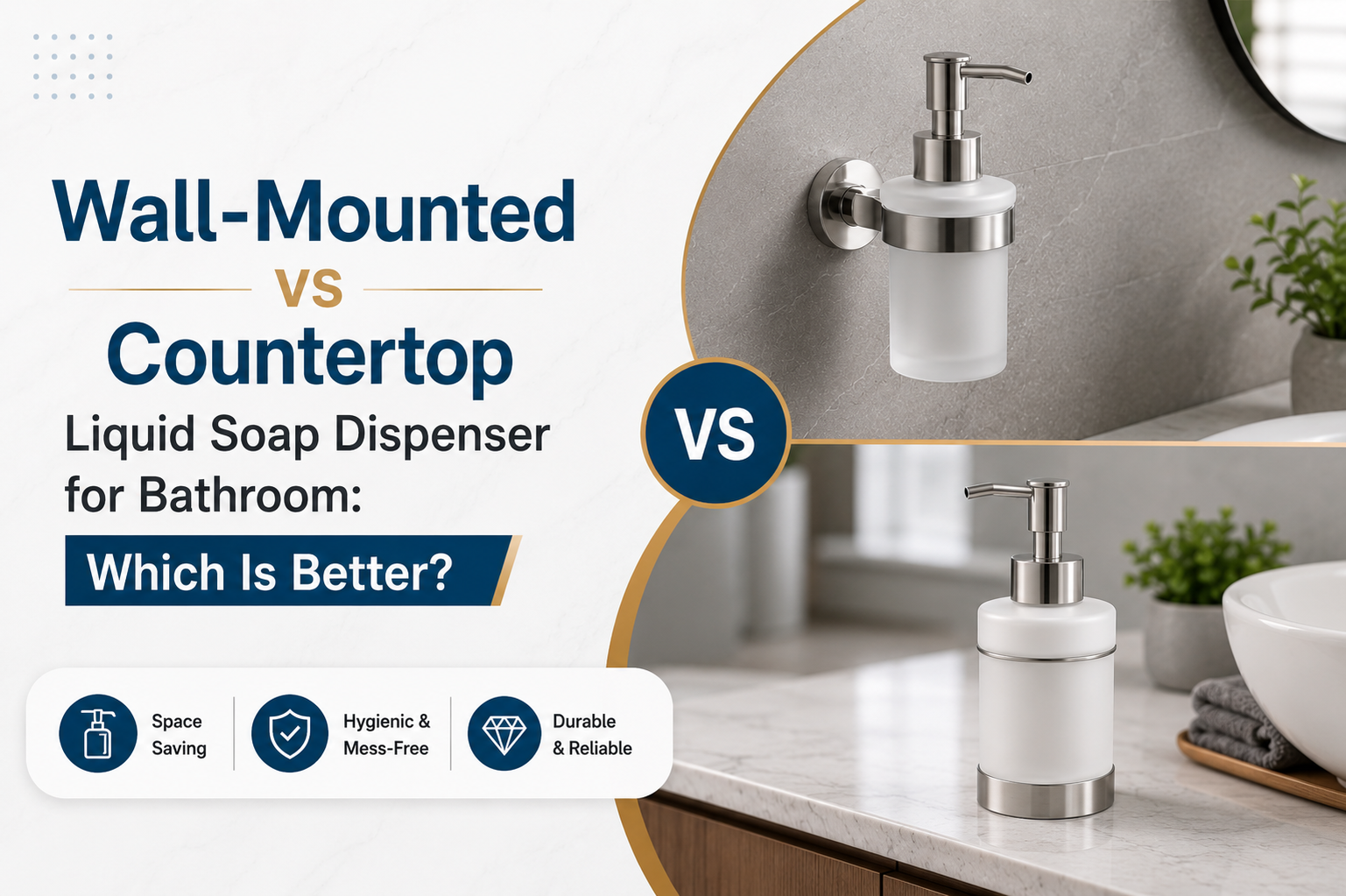
Wall-Mounted vs Countertop Liquid Soap Dispenser for Bathroom: Which Is Better?

Most people just grab whatever liquid soap dispenser for bathroom use happens to be sitting on the shelf at the store. Whatever matches the tap, or whatever’s cheapest that week. A few months later, the countertop one keeps tipping over every time someone bumps the counter, or the wall-mounted one turns out to be fixed in the wrong spot entirely. Neither is really a bad product. It’s just usually the wrong pick for that particular bathroom.

If you’re trying to work out which type actually suits your space, not just which one looks nicer online, here’s what actually matters.

What Is the Difference Between a Wall-Mounted and Countertop Liquid Soap Dispenser?

A wall-mounted liquid soap dispenser fixes directly onto the wall near the basin, freeing up counter space entirely. A countertop soap dispenser sits on the counter itself, usually refillable by unscrewing the top, and needs no drilling or installation at all. Wall-mounted ones suit busy or shared bathrooms; countertop ones suit smaller counters or rented spaces where drilling isn’t really an option.

FeatureWall-MountedCountertop
InstallationDrilling required, fixed positionNone, just place it
Counter space usedNoneSome, depending on size
StabilityCan’t tip overCan tip if bumped or knocked
RefillingTop-fill or cartridgeUnscrew and refill from top
Best forShared bathrooms, hotels, gymsVanity counters, guest bathrooms, rentals
Typical finish matchMatches other wall fittings easilyMatches vanity accessories and tray sets

Why Do Bathrooms Need a Dedicated Liquid Soap Dispenser Instead of a Bar of Soap?

A dispenser is simply more hygienic than a bar sitting in a wet dish. Bars pick up bacteria from every hand that touches them and stay damp between uses, which isn’t ideal in a household bathroom. That’s part of why it’s become such a common upgrade in family bathrooms with young kids.

There’s a practical side too. A dispenser controls how much soap actually comes out per pump, so a bottle lasts longer than a bar that ends up melting away in standing water. It also just looks tidier sitting on a counter that’s trying to stay minimal.

Which Type Suits a Small Bathroom Better?

Go wall-mounted if counter space is genuinely tight. Freeing up even a few inches of vanity makes a real difference in a small bathroom, and it stays free permanently, not just until someone sets a phone or a hairbrush down there.

Go countertop if you’re renting, if the wall near the basin is tiled in a way that makes drilling annoying, or if you’d rather keep the option to move the dispenser around whenever you feel like it.

How Do You Choose Between a Wall Mounted Liquid Soap Dispenser and a Countertop One?

A few things worth thinking through first. How many people actually use this bathroom day to day? More users usually means more chance of a countertop unit getting knocked over, so wall-mounted tends to hold up better there. Is the wall near the basin tiled or plastered? Tiled walls need proper anchors for a wall-mounted unit, and that’s a bigger job than most people expect going in.

Do you own the place or rent it? Renters generally can’t drill into tile, so countertop ends up being the safer, reversible choice. And how often does it need refilling? Countertop units are usually quicker to top up since there’s no bracket or wall plate getting in the way.

When Should You Choose a Countertop Soap Dispenser Over a Wall-Mounted One?

Pick countertop when the bathroom’s a guest space used occasionally, when you’re not planning to stay in the property long-term, or when you want something that visually matches a tray, tumbler, and soap dish already sitting there. It’s also just easier if you like rearranging your bathroom layout every so often, since nothing’s fixed down.

Can Bathroom Liquid Dispenser Manufacturers Match Your Modern Bathroom Accessories?

Yes, and this matters more than people realize until they actually see a mismatch sitting in their own bathroom. Established liquid dispenser manufacturers tend to offer the same unit across several finishes, chrome, matte black, brushed steel, so it can match existing taps, towel bars, and soap dishes instead of standing out as the one piece that doesn’t belong.

Veltrix, as one of the bathroom liquid dispenser manufacturers based in Rajkot, builds both wall-mounted and countertop dispensers across the same finish ranges used on its other modern bathroom accessories. That way a full matching set comes from one order, instead of you hunting down a dispenser separately somewhere else.

Should You Buy From Hand Soap Dispenser Manufacturers or a Generic Retailer?

Buy from a manufacturer if you actually want the thing to last and match everything else. Hand soap dispenser manufacturers can tell you exactly what the pump mechanism is made of, since cheap plastic pumps tend to jam or start leaking within a year of daily use. They can usually supply the same model again down the line too, if you need a replacement or want a second one for another bathroom.

A generic retailer sells whatever happens to be in stock that season, and finding the exact same finish six months later often just isn’t possible. Fine for a quick, cheap buy. Not great if you’re fitting out several bathrooms and want everything to actually match.

Conclusion

Whether a wall-mounted or countertop liquid soap dispenser for bathroom use suits you better really comes down to counter space, how many people use the bathroom, and whether you can drill into the wall at all. Get that part right, and the dispenser just quietly does its job for years instead of becoming another thing you have to replace.

Veltrix manufactures liquid soap dispensers from its facility in Rajkot, alongside a full range of modern bathroom accessories built to match across finishes. If you’re planning a bathroom fit-out and want fittings that’ll still match five years from now, it’s worth talking to a manufacturer directly rather than picking pieces from different sellers.

Frequently Asked Question

Q1: Are wall-mounted soap dispensers better than countertop ones? 

Not universally, they’re just suited to different bathrooms. Wall-mounted wins on stability and free counter space. Countertop wins on easy installation and flexibility, especially in rented spaces.

Q2: How often does a liquid soap dispenser need refilling? 

Depends on household size, but a standard 300 to 500ml dispenser in a two-person bathroom usually needs topping up every three to four weeks with normal daily use.

Q3: Can a wall-mounted soap dispenser be installed without drilling? 

Some adhesive-mounted options exist, but they’re less reliable over time, especially once a full bottle adds real weight. A properly anchored wall-mounted unit holds up much better long-term.

Q4: What finish options are usually available for bathroom soap dispensers? 

Chrome, matte black, and brushed steel are the most common, matching what’s typically available across other bathroom accessories like towel bars and soap dishes.

Q5: Do liquid dispenser manufacturers offer bulk orders for hotels or offices? 

Yes, most established manufacturers supply bulk orders for hospitality and commercial projects, usually with consistent finish and refill mechanisms across every unit in the order.
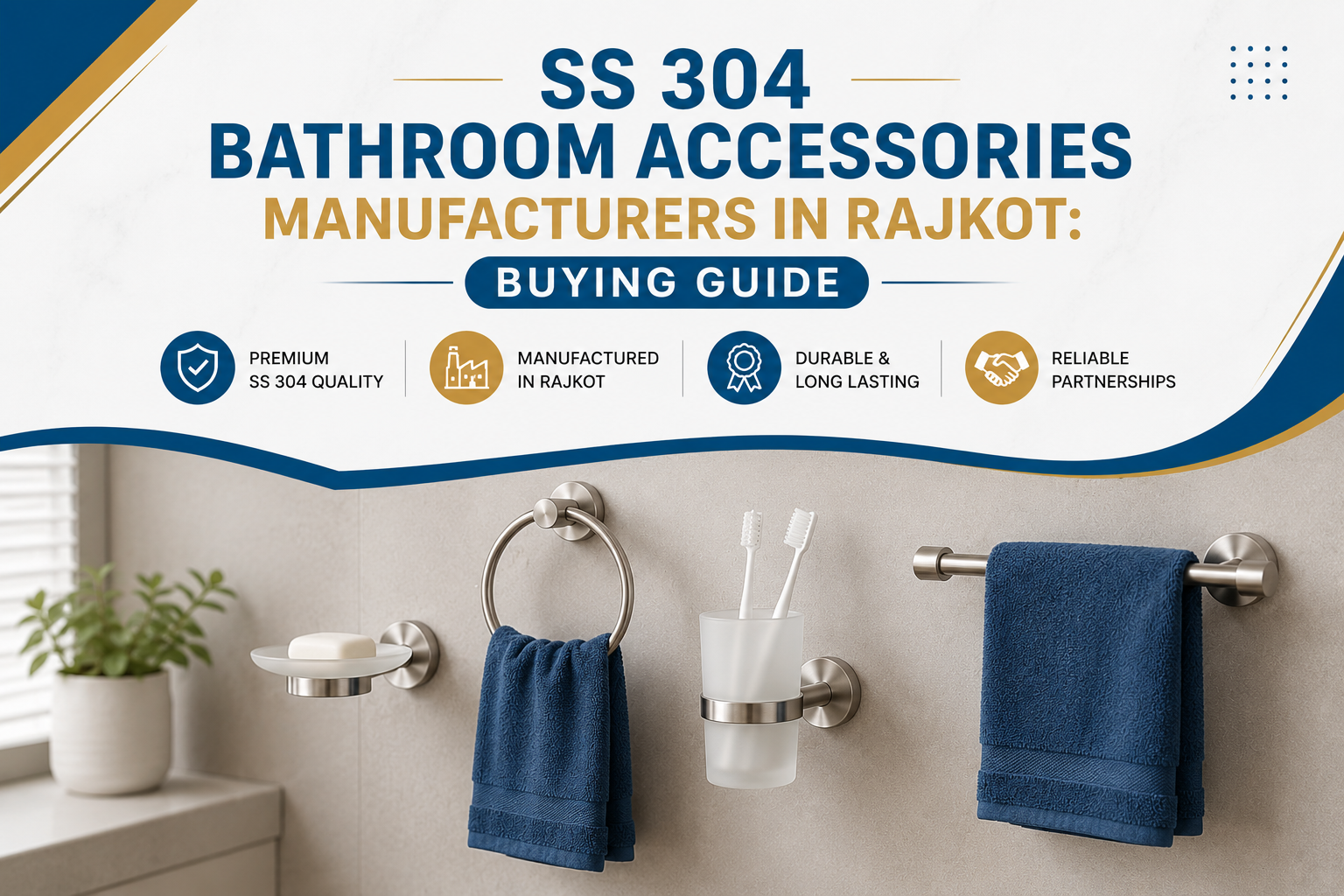
SS 304 Bathroom Accessories Manufacturers in Rajkot: Buying Guide

Ask five sellers what “stainless steel” means and you’ll get five different answers. At least two of them will be wrong. Some grades start rusting within a year in a humid bathroom, while others go a decade without a single spot of discoloration. Nine times out of ten, the difference comes down to something buyers never think to ask about upfront: the actual steel grade.

This one’s for architects, contractors, and homeowners trying to work out how SS 304 bathroom accessories manufacturers in Rajkot actually operate, why this particular grade is worth paying extra for, and how to tell a real manufacturer apart from someone just reselling stock they never touched.

What Does SS 304 Actually Mean for Bathroom Accessories?

SS 304 is a stainless steel grade made up of roughly 18% chromium and 8% nickel. That mix is what gives it strong rust and staining resistance in humid spaces like bathrooms, which is why most serious manufacturers reach for it on:

  • Soap holders and dishes
  • Towel bars and racks
  • Robe hooks and paper holders
  • Basically anything dealing with daily water contact

Cheaper alternatives looks identical, but they’re not the same thing at all. SS 202 has a lower nickel content, so it spots and dulls faster even though nobody can tell just by looking at it. Chrome-plated mild steel is worse still. There’s no real corrosion-resistant base underneath, just a thin plated layer sitting over ordinary steel.

The difference only becomes obvious after six months of actual daily use, when the weaker grade starts showing faint orange spots near the screw holes or bracket joints, usually right where water tends to sit and collect.

GradeChromium / NickelRust ResistanceTypical Use
SS 304~18% chromium, ~8% nickelHigh, holds up for years in wet areasSoap holders, towel bars, towel racks
SS 202Lower nickel contentModerate, prone to spotting over timeBudget fittings, low-moisture areas
Chrome-plated mild steelNo real chromium/nickel baseLow, plating wears and rust followsCheapest fittings, short lifespan

Why Do SS 304 Bathroom Accessories Manufacturers in Rajkot Matter for Buyers?

Rajkot’s built its name on brass and stainless steel hardware manufacturing over several decades now, and honestly, that history matters once you’re sourcing fittings in bulk. Skilled labor’s already in place here, not something that needs training up from scratch. Tooling’s been refined over years of running the same processes. Raw material supply chains stay local instead of leaning on imports.

For buyers, that history shows up in a few concrete ways. Bulk orders tend to move faster since production isn’t waiting on imported steel to clear customs. Inspecting quality before a large order is easier too, since the factory floor is right there rather than somewhere overseas. Pricing tends to be more competitive as well, simply because the SS 304 sheet and rod supply chain is already local. And there’s just a bigger pool of manufacturers to actually compare, instead of being stuck picking between one or two national suppliers.

Which Bathroom Fittings Should Always Be SS 304?

Not every accessory needs the top grade. But a handful see enough water contact that cutting corners shows up fast, sometimes within months rather than years.

Stainless steel soap dish holder sits in near-constant contact with water and soap residue, so it’s usually the first fitting to show rust if the grade’s wrong somewhere. 

Stainless steel towel rod carries repeated weight from wet towels every single day, which means the load-bearing brackets need to hold their finish under real stress, not just look shiny the day they’re installed.

304 stainless steel towel rack tends to span a wider footprint with multiple bars, so the grade has to stay consistent across every joint. One weak point in a mass-manufactured rack usually fails well before the rest of the unit does.

How Do You Verify a Bath Fitting Manufacturer Is Actually Using SS 304?

Two things worth doing before placing a large order. First, ask for a material test certificate, usually shortened to MTC. Most legitimate manufacturers hand this over without much fuss for bulk orders, and it confirms the exact composition of the steel batch that was actually used, rather than you just taking someone’s word for it.

Second, try a basic magnet test. SS 304 is only weakly magnetic, so if a strong magnet pulls hard toward the fitting, that’s usually a sign of a cheaper grade dressed up with chrome plating. Not foolproof on its own, but paired with an MTC request, it filters out most sellers who are quietly cutting corners.

When Should You Buy From Bathroom Accessories Wholesalers Instead of a Single Manufacturer?

Really depends on how big the project is.

Wholesalers make more sense when:

  • You need a mix of brands or finishes for a smaller job
  • You’d rather not juggle several manufacturer relationships at once
  • It’s a single home renovation or a smaller retail order

Going direct to a manufacturer makes more sense when:

  • You’re fitting out a hotel or a residential complex with dozens of near-identical bathrooms
  • Consistent finish across every unit actually matters
  • You want direct pricing, without a wholesaler’s margin stacked on top
  • You need someone who can answer a real question about steel grade instead of passing it along

Can Bath Accessories Manufacturers in Rajkot Handle Custom Bulk Orders?

Yes, and honestly, this is where working with an established manufacturer pays off the most. Most bath accessories manufacturers in Rajkot running their own in-house production can adjust bracket lengths and mounting points, switch finish types between chrome, matte black, or brushed steel, and handle packaging for large or export orders. A reseller just can’t do any of that, since they don’t control the manufacturing line themselves.

Take a hotel project needing 200 identical bathroom sets, for instance. That kind of order really only works well with a manufacturer who can hold the exact same finish and dimensions across every unit, rather than sourcing from three different suppliers and hoping the batches end up close enough.

Should You Choose a Bathroom Accessories Supplier Based on Price Alone?

No, and this is probably the single most common mistake buyers make. A bathroom accessories supplier quoting a price well below the market rate for “SS 304” fittings is almost always cutting something, whether that’s the steel grade itself, the finish thickness, or the wall gauge of the fitting. Sometimes all three.

A fairer way to compare suppliers is to request quotes for the exact same specification, same gauge, same grade, same finish, and treat any price that’s dramatically lower as a reason to ask more questions. Not a reason to place the order right away.

Conclusion

Getting SS 304 bathroom accessories right isn’t really about finding the shiniest fitting on a catalogue page. It comes down to verifying the steel grade before you buy, understanding why Rajkot’s manufacturing base makes sourcing genuinely easier, and knowing which fittings, a soap holder or towel bar especially, need SS 304 the most because of constant water exposure.

Veltrix manufactures SS 304 bathroom accessories out of its own facility in Rajkot, working directly with architects, contractors, and homeowners on everything from single-bathroom orders to full bulk hotel projects.

Frequently Asked Question

Q1: What is SS 304 and why is it used in bathroom accessories?

It’s a stainless steel grade, roughly 18% chromium and 8% nickel, and that combo is what keeps it from rusting or staining in a humid bathroom. Most manufacturers default to it for anything that touches water regularly, soap holders and towel bars especially.

Q2: How can I tell if a bathroom accessory is genuinely SS 304?

Honestly, just ask the manufacturer for a material test certificate. That’s the real answer. A magnet can give you a rough clue too, since SS 304 barely responds to one, but don’t rely on that alone, pair it with the certificate.

Q3: Is SS 304 better than SS 202 for bathroom fittings?

Yeah, in most cases. The higher chromium and nickel in 304 just holds up better against corrosion once things get wet. SS 202 is cheaper upfront, but you’ll start seeing rust around the screws and joints sooner than you’d like.

Q4: Do SS 304 bathroom accessories cost more than standard alternatives?

A little, somewhere in the 15 to 30% range depending on what you’re buying. But that extra cost tends to pay for itself, since you’re not replacing rusted fittings every couple of years like you would with a cheaper grade.

Q5: Why is Rajkot a preferred destination for bathroom accessories manufacturing?

Rajkot is known for its strong engineering and manufacturing industry. Many manufacturers in the city use modern production techniques, skilled workmanship, and strict quality control to produce premium stainless steel bathroom accessories.

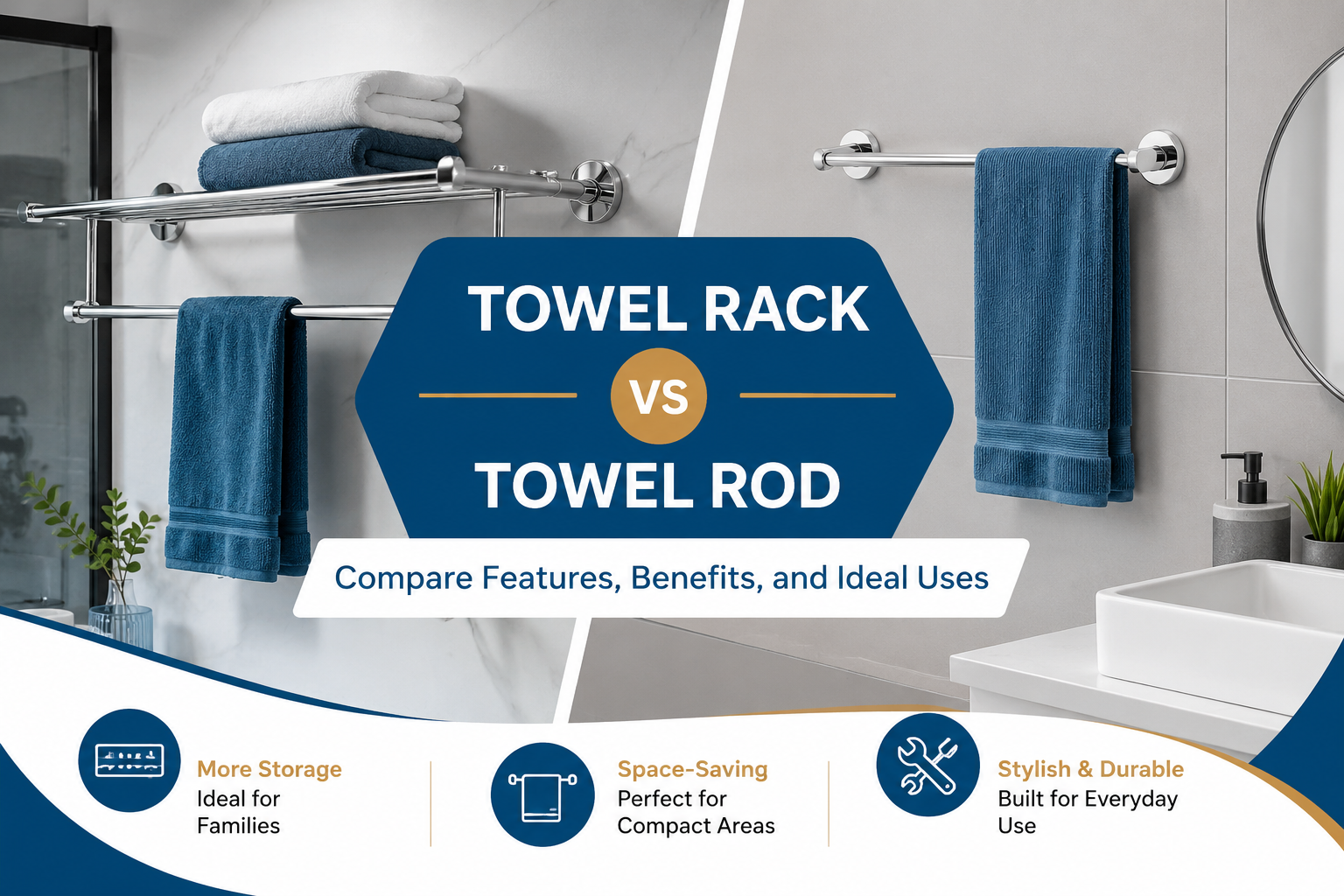
Towel Rack vs Towel Rod: Compare Features, Benefits, and Ideal Uses

Nobody thinks about towel racks until they’re standing in a showroom staring at two bars that look almost identical, trying to decide which one to buy. Feels like a throwaway decision. It’s not, though. Get it wrong and you’re looking at years of damp towels bunched onto a hook because the towel hanger you bought was never going to fit two or three people using the same bathroom every morning.

This is for anyone renovating, building from scratch, or just swapping out something rusted, and trying to figure out whether a towel rack or a towel rod is actually right for their bathroom. Most of what’s below comes from installation feedback across real residential and hospitality jobs, not a spec sheet someone typed up in an office.

What Is the Difference Between a Towel Rack and a Towel Rod?

A towel rod is one straight bar, usually held up by two end brackets, meant for a single towel to hang flat and dry properly. A towel rack has multiple bars, or sometimes a ladder-style frame, and it’s built to hold several towels at once. If your bathroom is tight on space, go rod. If more than one person’s sharing the bathroom, go rack.

FeatureTowel RodTowel Rack
Number of towels heldOneTwo or more
Wall space neededLowModerate to high
Drying speedFaster, towel hangs flatSlower if towels overlap
Best bathroom typeGuest, ensuite, minimalistFamily, shared, hotel rooms
Typical length18–24 inches24 inches and up, or ladder-style
Installation points2 brackets2–4 brackets or full frame

Which One Should You Choose for a Small Bathroom?

The rod, honestly. A bath towel rod sticks out less, takes up less wall, and matters a lot more than people expect when the bathroom door swings inward or the gap between the basin and shower is already narrow to begin with.

It dries towels quicker too, just because nothing’s bunched up against itself. But here’s the catch: if two people are sharing that bathroom every single morning, one towel rod for bathroom use won’t cut it on its own. You’ll end up with a second towel draped over the door handle, which is exactly the mess you were trying to avoid. At that point, either a slim double-bar towel rack for bathroom spaces or two rods spaced apart does the job better than cramming everything onto one bar.

Why Does a Wall-Mounted Towel Rack Matter More Than the Design Does?

Placement is honestly what makes or breaks either option day to day, more than whatever finish or design you picked. Put a towel rod too close to the shower door and it gets splashed every single time someone steps out. Put it too far away and nobody bothers walking over for it, so it ends up on the floor within a week. We’ve seen this happen more times than we can count.

A towel rack wall mounted correctly should sit within arm’s reach of wherever you actually dry off, not shoved into whatever corner had free wall space. There’s a pattern we notice on site visits: a bathroom that’s otherwise well thought out, tiles picked carefully, fittings matched, and then the towel hanger in the bathroom is clearly an afterthought, you can tell because there’s a damp towel sitting on the counter instead of on the rack six feet away.

Height matters too, though people rarely think about it upfront. Chest height for adults works for most households, somewhere around there. If kids are using the bathroom, a lower second bar tends to actually get used, instead of one mounted purely for adult reach.

How Do You Install a Bath Towel Rod or Bathroom Towel Rack Properly?

Installation isn’t hard, but it fails in the same handful of ways every time. The brackets need to hit a wall stud or use proper anchors, especially on tiled walls, because a wall-mounted towel rack loaded with wet towels is putting continuous pull on those fixing points, not a one-time load. That’s the real reason racks come loose within a year: bad fixing, not a bad rack.

After that, it’s mostly about spacing. Leave enough gap between the rack and the wall so a towel can actually hang and breathe, rather than just touching tile and staying damp all day. And if you’re mounting near a heated towel setup or underfloor heating, check the clearance guidance first. Some finishes don’t handle sustained heat the same way others do.

When Should You Use a Towel Rack for Bathroom Instead of a Towel Rod for Bathroom?

Go with a rack once more than one towel needs somewhere to hang, or the bathroom’s shared by a family, or you want hand towels kept separate from bath towels instead of stacked on top of each other. Ladder-style racks also do well in bathrooms that double as a drying spot for laundry, since they simply hold more without things overlapping.

A rod fits guest bathrooms, smaller ensuites, anywhere one towel at a time genuinely covers it. It also just looks better in a minimalist bathroom. A bulky towel hanger tends to look out of place against clean, simple fittings.

Can a Towel Rack Manufacturer in Rajkot Match International Quality?

Yes, and honestly, the local option often holds up better long-term. Rajkot’s been a brass and stainless steel manufacturing hub for decades now, so bathroom accessories manufacturers usually work with the same SS304-grade steel international brands use, minus the import markup and the long wait for a replacement part.

Veltrix, as one of the bathroom towel bar manufacturers based in the city, builds and finishes its entire range in-house, which is a big part of why finish consistency across a bulk order holds up. Say you’ve got forty identical hotel rooms to fit out: sourcing from three or four smaller vendors almost never gives you that same consistency, and towel rod manufacturers in Rajkot with in-house production tend to manage bulk timelines better for exactly that reason.

Should You Choose a Towel Rack Supplier or a Towel Rod Manufacturer Over a Hardware Store?

Go with a proper towel rack supplier or towel rod manufacturer if you actually want the fitting to last. They can tell you the exact steel grade, match the finish across the rest of your bathroom accessories, and usually replace one damaged piece without forcing you to buy the whole set over again.

A hardware store sells whatever happens to be on the shelf that week, and half the time nobody there knows what’s actually behind the chrome plating. Fine for a quick cheap fix. Not fine when you’re doing a full bathroom fit-out where every piece needs to match and hold up for a decade of daily use. This is also where working with a dedicated towel rack manufacturer pays off, since they can hold the same finish across dozens of units without you chasing five different vendors.

Conclusion

Veltrix manufactures and supplies towel racks and towel rods from Rajkot, working as a trusted towel rack supplier and one of the established bathroom towel bar manufacturers for architects, interior designers, and homeowners across India, on standard finishes as well as custom bulk orders. Planning a fit-out and wanting fittings that’ll still match in five years? Worth talking to a manufacturer directly instead of guessing at a showroom.

Frequently Asked Question

Q1: How many towel bars or rods does an average family bathroom actually need?

Two, usually. One per person for daily use, and if there are kids in the house, it helps to hang the second one a bit lower so they actually reach it instead of dumping the towel on the floor.

Q2: What’s the standard length of a bathroom towel rod?

Somewhere between 18 and 24 inches covers most folded bath towels without the ends flopping against the wall. If the bathroom’s on the wider side, some people go up to 30 inches, but honestly, once you’re past that, you’re better off with a rack.

Q3: Can a towel rack also hold a bathrobe or hand towels?

Yeah, that’s actually pretty common with the ladder-style ones. Bath towel on one bar, robe on the next, hand towels down at the bottom, and none of it ends up tangled together.

Q4: Do towel racks and rods need to match the finish of other bathroom fittings?

Not strictly, but it shows when they don’t. Put a chrome rod next to a matte black tap and soap dispenser, and that mismatch is usually the first thing people notice, even if they can’t say why the bathroom feels off.

Q5: How much weight can a wall-mounted towel rack safely hold?

More than people worry about, as long as it’s anchored into a wall stud and not just stuck to the tile. Soaked towels aren’t really the problem here; a weak fixing point is what actually gives way.

Modern Bathroom Decor Accessories for Minimalist Interiors

Take a look at most bathrooms renovated a decade ago, and you’ll spot the same problem: a yellowed plastic soap dish, a towel hook that’s come loose from the wall, and a dispenser that doesn’t match anything else in the room. Modern bathroom accessories solve this, and honestly, they do it without requiring you to spend a fortune or end up with a bathroom that feels too precious to actually use.

This guide is for anyone fitting out or renovating a minimalist bathroom and trying to figure out which modern bathroom decor accessories are actually worth buying, what finishes hold the aesthetic together, and what to avoid.

What Makes a Bathroom Accessory Work in a Minimalist Interior?

A minimalist bathroom is built on three things: clean lines, consistent finishes, and no visual clutter. An accessory earns its place in that space only if it does one of the following:

  • Serves a clear daily function
  • Sits flush or close to the wall so it does not interrupt the visual flow
  • Matches the finish of every other fitting in the room

Anything that does not meet at least two of those three criteria adds noise to a space that is supposed to be quiet. That is the filter to run every purchase through before you commit to it.

Why Do Modern Bathrooms Need the Right Accessories?

Here’s something we see constantly: a bathroom with beautiful tiles and a decent vanity that still somehow looks unfinished. Nine times out of ten, it’s the accessories dragging the whole thing down.

A rose-gold tap paired with a plastic soap dish just looks like nobody planned it, even if the tiling cost a fortune. Glass and stainless steel also hold up far better against humidity than plastic, which tends to warp or discolour within a couple of years in Indian bathrooms. They’re easier to wipe clean too, since smooth surfaces don’t trap soap scum the way textured plastic does. And frankly, good fittings just don’t need replacing every time you repaint, which saves money you’d otherwise spend redoing the same small stuff.

Which Modern Bathroom Decor Accessories Actually Matter?

A minimalist bathroom needs a wall-mounted soap dish, toothbrush holder, paper holder, towel rod, robe hook, and liquid dispenser at minimum. Each should be wall-mounted, finish-matched, and chosen from the same design series so the space reads as intentional rather than assembled piece by piece. These are the modern bathroom decor accessories worth prioritising first, before anything decorative.

Glass soap dish: Drains water better than plastic and won’t stain over time. Because it’s transparent (or lightly tinted), it makes a small bathroom feel less cluttered instead of adding to the mess.

Glass toothbrush holder: Pairs naturally with a glass soap dish so the counter looks like it belongs together. It’s also harder to ignore when it needs cleaning; plastic tends to hide grime that glass just won’t.

Liquid soap dispenser: More hygienic than a bar sitting in a dish, obviously. But we’ve also noticed it’s become one of the most-requested swaps in family bathrooms with young kids, probably because bars of soap and toddlers don’t mix well.

Bathroom towel rack: This one’s really about storage more than style. In a tight bathroom, a rack placed well keeps towels off the floor and off the back-of-door hook, which is usually the first thing that makes a bathroom look messy.

Bathroom towel bar: Works better than a full rack when you just need one or two towels within reach of the shower and don’t have wall space to spare. A lot of our clients use a bar near the basin and a full rack closer to the shower.

Which Finish Works Best in a Minimalist Bathroom?

Snippet answer: Matte black and chrome are the two finishes that suit minimalist bathrooms best. Matte black gives strong, graphic contrast against white or grey tiles. Chrome keeps the space light and clean without drawing attention to itself.

Here is how to choose between them:

Your Bathroom PaletteRecommended Finish
White tiles, white walls, neutral groutChrome or Matte Black
Grey tiles, concrete effect, dark groutMatte Black
Warm white, beige, or off-white tonesChrome or Rose Gold
Wooden vanity, warm neutral tonesGold or Rose Gold

The most important thing is not which finish you choose, but that you use it consistently. Every fitting in the bathroom—paper holder, soap dish, toothbrush holder, towel rod, robe hook, and dispenser should be in the same finish. One gold fitting among chrome ones breaks the whole visual rule minimalism runs on.

Which Veltrix Series Suits a Minimalist Bathroom?

Veltrix, one of the established bathroom accessories manufacturers in India, makes its full range across six design series. For minimalist interiors specifically, two series stand out.

FUSION is the most natural fit for a minimalist bathroom. The bracket design is clean and angular, available in chrome and matte black, which are the two finishes minimalist interiors call for most often.

ARIES works particularly well in compact minimalist bathrooms. The design is sharp and structured, also available in chrome and matte black, and the proportions suit smaller wall spaces without looking undersized.

For warmer minimalist interiors, IRIS and LUIZ in rose gold or gold add warmth without adding clutter.

Here is a quick reference across the full range:

Your PriorityBest SeriesAvailable FinishesWhy It Works
Best value, clean lookELITEChromeSimple design, no unnecessary detailing
Warm or traditional feelRUSTICChromeTextured finish suits natural material interiors
Maximum finish choiceIRIS or LUIZChrome, Gold, Rose GoldThree finish options in one series
Bold contrast lookFUSIONChrome, Black MattAngular design built for dark, modern spaces
Small bathroom, tight wall spaceARIESChrome, Black MattCompact proportions without looking undersized
Premium or hospitality projectLUIZChrome, Gold, Rose GoldMost refined metalwork across the full range

Should You Buy From Bathroom Accessories Manufacturers in India or Import?

For most Indian homes and projects, going local just makes more sense practically. Bathroom accessories manufacturers in India understand things imported catalogues don’t account for, like local water hardness, humidity, and how installation actually works on Indian wall types. All of that affects how long a finish actually lasts.

Imported pieces can look great in photos, sure. But try getting a replacement part or filing a warranty claim six months later, and the appeal fades fast. There are cases where an imported finish genuinely fits a client’s brief, we won’t pretend otherwise, but for everyday renovations, sourcing locally usually wins on both support and turnaround.

What Makes Veltrix a Reliable Bathroom Accessories Manufacturer?

Veltrix is among the bathroom accessories manufacturers in Rajkot with a facility that’s been running in Rajkot, Gujarat for over two decades. The full product range is built and finished in-house, which means finish consistency, material quality, and delivery timelines are all managed under one roof, not outsourced across three different vendors.

As a bathroom accessories supplier working with homeowners, interior designers, architects, and contractors, Veltrix supplies both individual pieces for single bathrooms and bulk orders for large residential or hospitality projects. Being one of the few bathroom accessories manufacturers in Rajkot with all six series and four finishes produced at one facility means a complete matching set for any bathroom style can be sourced from a single conversation with the team, rather than five separate ones.

Frequently Asked Questions

Q1: What material is best for modern bathroom accessories?

SS304 stainless steel and toughened glass are your safest bets. Steel resists rust and handles humidity well, while glass keeps things looking light and is genuinely easy to keep spotless.

Q2: Are glass bathroom accessories safe and durable?

Yes, as long as it’s toughened or tempered glass. It’s built to resist chipping and cracking under normal daily use, which is why it’s become standard in modern fittings.

Q3: How do I match accessories to my bathroom’s style?

Pick one finish—matte black, brushed steel, chrome, or another option—and stick to it across every piece, including taps. Mixing finishes is the most common reason a bathroom ends up looking unplanned.

Q4: How often should bathroom accessories be replaced?

Quality stainless steel or glass accessories can easily last 8–10 years with normal use. Replace them sooner only if you notice rust, cracks, or they no longer match your renovated bathroom.

Q5: Is it better to buy accessories as a set or pick them individually?

Buying a matching set keeps the finish and proportions consistent, making it much easier to achieve a cohesive bathroom design than sourcing individual pieces from different sellers.

WhatsApp Us Get Quote