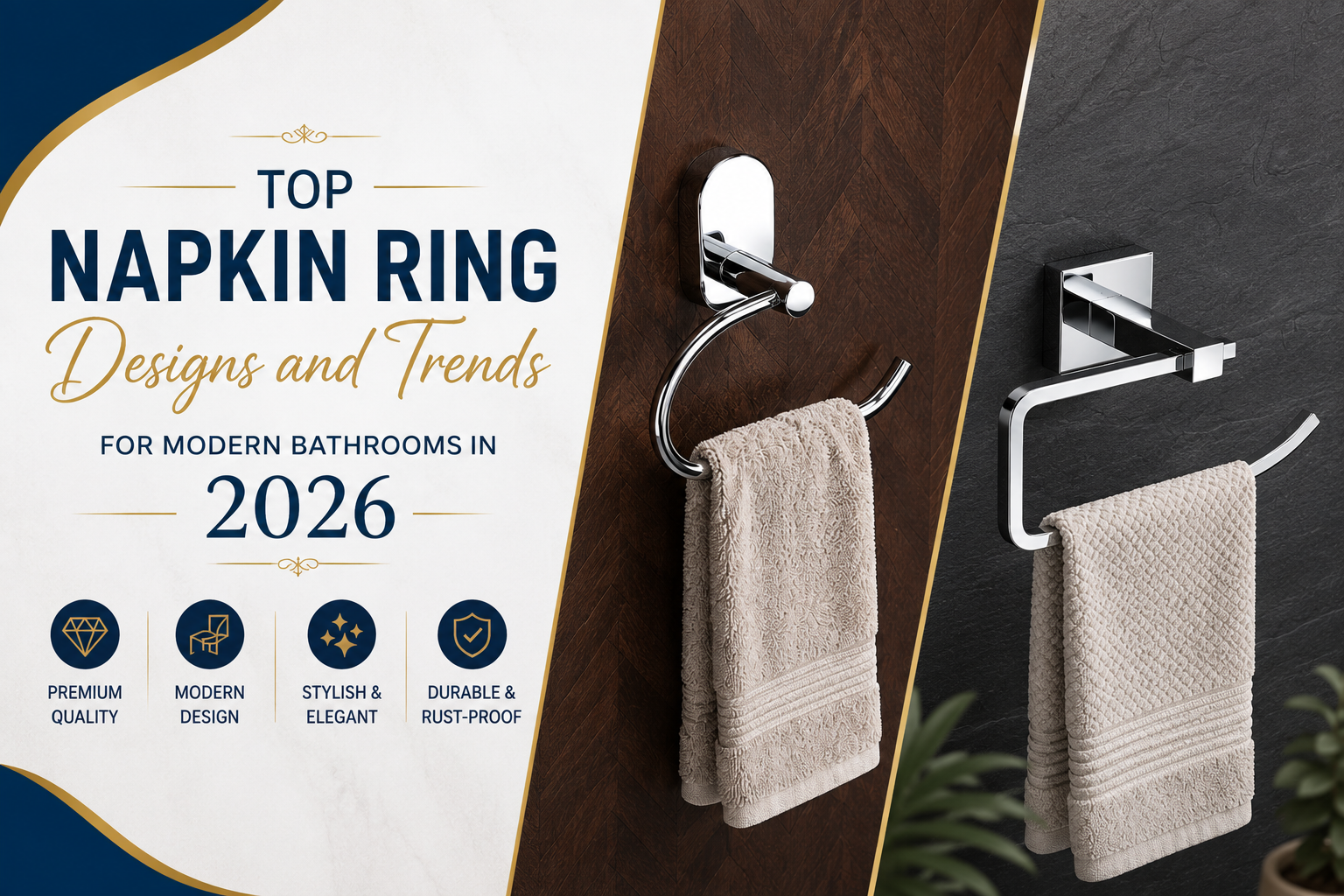
Top Napkin Ring Designs and Trends for Modern Bathrooms in 2026

A dealer asked us last month why a customer kept calling it a “napkin ring” when she clearly meant the little loop near her basin for hanging a hand towel. Fair confusion, honestly. That’s the actual trade term in a lot of Indian bathroom fittings catalogues, but most people picture the metal rings that hold cloth napkins at a dinner table when they hear it. Different fixture entirely. In a bathroom, it’s a small wall-mounted piece meant to hold a folded hand towel within reach of the sink, nothing to do with the dining table version.

If you’re shopping for that specific fixture and trying to work out what finish and size actually suits your bathroom this year, here’s what’s worth knowing.

What Is a Bathroom Napkin Ring, Exactly?

Basically a small loop, usually somewhere between 4 and 6 inches across, mounted near the basin to hold one folded hand towel. Smaller than a full towel bar, and it’s not meant for a bath towel, so it fits well in powder rooms, guest bathrooms, or anywhere the counter’s already tight on space.

Why Napkin Rings Are Showing Up More in Bathroom Decor Accessories

Bathrooms have gotten fussier about detail over the last few years, not just the tiles and taps but the smaller bathroom decor accessories that used to get ignored entirely. A napkin ring fills a real gap, hand towels need somewhere to hang that isn’t a full-size bar meant for something much bigger.

There’s a hygiene side to it too, which people don’t always think about upfront. A hand towel on its own ring dries faster and stays separate from the bath towel, and that actually matters more in a shared or guest bathroom than it sounds like it should.

Which Napkin Ring Designs Are Actually Trending This Year?

A handful of patterns keep turning up across newer bathroom projects. Slim, minimal hoops in matte black or brushed steel, matching the broader move toward quieter, less flashy hardware. Gold and rose gold finishes too, mostly in powder rooms and guest bathrooms where a bit of warmth doesn’t feel out of place. Double-ring designs are catching on as well, holding two hand towels side by side, which helps in busier shared bathrooms. And plain circular rings are slowly giving way to slightly angular, geometric shapes.

Design TrendFinish OptionsBest Suited For
Slim minimal hoopMatte black, brushed steelModern, minimalist bathrooms
Gold or rose gold ringGold, rose goldPowder rooms, guest bathrooms
Double-ring holderChrome, matte black, goldShared family bathrooms
Geometric ringMatte black, brushed steelContemporary, design-led interiors

How Do You Actually Pick the Right One for Your Bathroom?

Match the finish to whatever’s already on the taps and towel bar, that’s step one. A mismatched ring stands out a lot more than you’d expect once it’s actually up on the wall. After that, think about size against the space you’ve got, a bulky double-ring holder looks wrong crammed into a genuinely small powder room.

Material matters more than people assume too. A stainless steel napkin ring, SS304 grade especially, holds up fine against daily humidity and won’t go dull or spotty the way a cheap plated version tends to within a year.

When Does Gold Actually Make Sense Over Steel?

Powder rooms, guest bathrooms, anywhere the whole space leans a bit warmer and more formal, darker tile, wood vanity, warmer lighting, that kind of setup. Gold napkin rings manufacturers usually offer both a bright gold and a brushed or antique finish, and the brushed one tends to age better with daily handling, less obvious wear over time compared to a high-shine finish.

Steel’s the better call in a bathroom that gets hammered daily by a family. It just takes wear better and doesn’t need the gentler handling a plated gold finish sometimes wants.

Can Napkin Ring Manufacturers Actually Match a Full Bathroom Set?

Yes, and it’s worth checking before buying a napkin ring on its own, actually. Decent napkin ring manufacturers, us at Veltrix included, build these across the same finish ranges used on towel bars, soap dishes, dispensers, so it doesn’t end up being the one odd piece out in an otherwise matched bathroom.

We make napkin rings in stainless steel and gold-finished variants out of our Rajkot facility, right alongside the rest of the accessory range, so a full set can come from one order instead of a separate hunt for what’s honestly the smallest fixture in the whole bathroom.

Find Stylish Bathroom Napkin Rings

Explore stylish stainless steel and gold-finished napkin rings from Veltrix, designed to complement your bathroom fittings and interior style.

Explore Napkin Rings →

Should You Go Through a Napkin Ring Supplier Directly, or Just a Retailer?

Go direct if you’re fitting out more than a bathroom or two, or if matching finish across the set genuinely matters to you. A manufacturer or supplier can usually tell you the exact plating thickness and base material, which a retailer selling whatever’s on the shelf that week often just can’t.

For a single quick replacement though, retail’s fine. Speed matters more than precision matching in that situation.

Conclusion

Small fixture, sure, but napkin rings are one of the easier ways to finish off a bathroom’s look without touching anything major. Minimal steel hoop or warmer gold finish, it really just comes down to the rest of your bathroom’s palette and how much daily handling the piece needs to survive.

Veltrix manufactures napkin rings and the wider range of bathroom decor accessories out of Rajkot, working with dealers, designers, and homeowners across India. Whether it’s one stainless steel napkin ring for a guest bathroom or you’re going through a napkin ring supplier for something bigger, pick a finish that actually continues from the rest of your fittings. Don’t treat it as an afterthought, it shows.

Frequently Asked Question

Q1: What’s the difference between a napkin ring and a towel ring in a bathroom?

Napkin ring’s smaller, built for one folded hand towel. Towel ring’s bigger, meant for a full bath towel. Both mount on the wall, just different scales entirely.

Q2: Does a gold napkin ring tarnish over time?

Not much, if it’s a genuine gold-plated finish on a decent base metal. Wipe it dry after use instead of leaving it wet though, that alone extends the finish’s life quite a bit.

Q3: Is stainless steel or brass better for a bathroom napkin ring?

Steel, generally, SS304 grade especially. It handles daily humidity with less fuss than brass, which needs regular polishing or it starts developing a patina.

Q4: Can I get a napkin ring that matches my existing towel bar and soap dish?

Usually, yes. Most manufacturers with a full accessory range offer napkin rings in the same finishes as their towel bars and soap dishes. Just ask specifically for a matching set, don’t assume it’s automatic.

Q5: What size napkin ring works best for a small powder room?

Somewhere around 4 to 5 inches usually works well. Go bigger than that in a small space and it starts looking bulky fast.
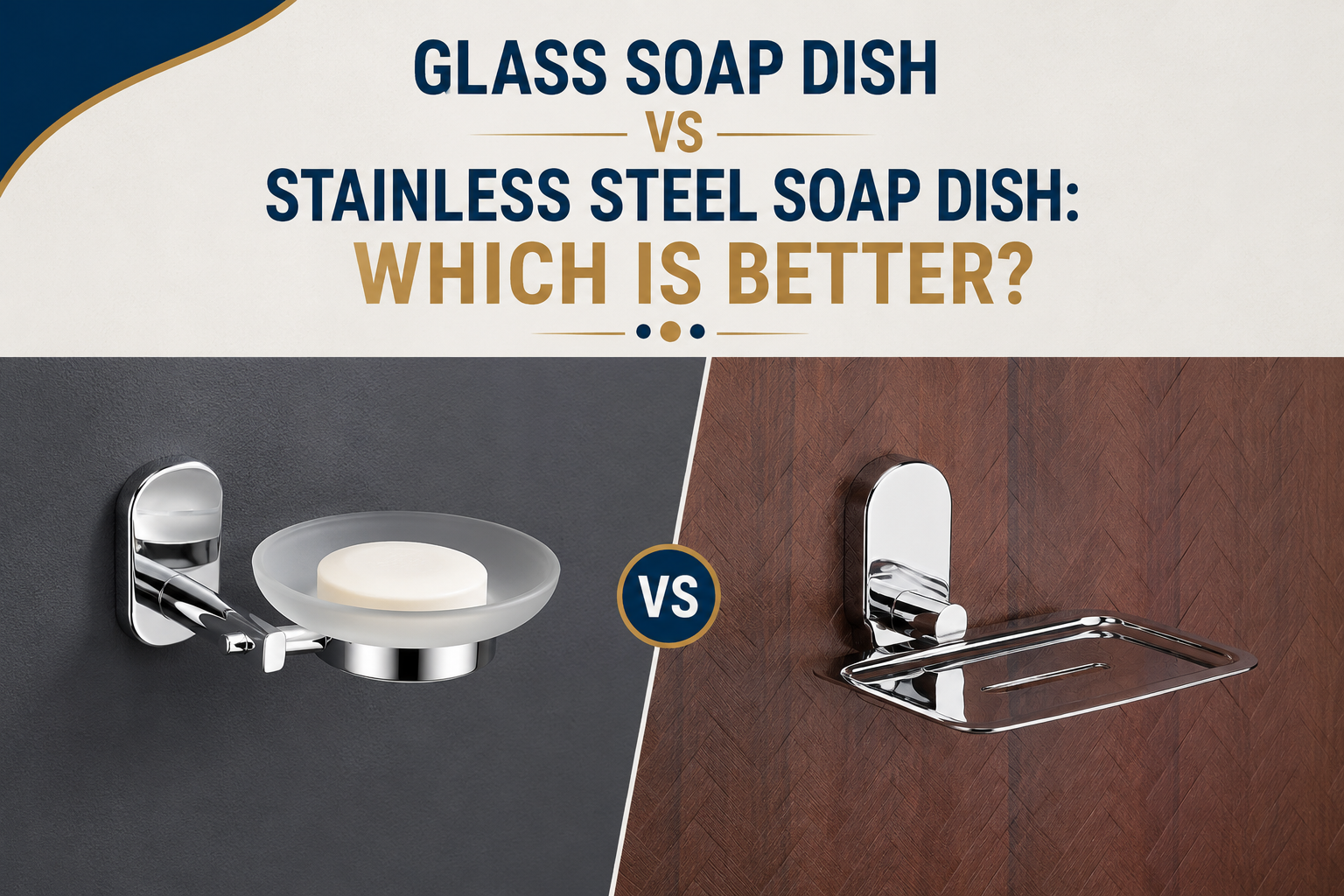
Glass Soap Dish vs Stainless Steel Soap Dish: Which Is Better?

Most people don’t really choose a soap dish. They just grab whatever’s paired with the rest of the bathroom set and move on. Fine, until six months later the glass one’s got a chip from a dropped shampoo bottle, or the steel one’s gone dull because nobody wiped it down as often as they should’ve. By then it’s a bit late to ask which material actually suited the way the bathroom gets used.

So, glass or steel. Here’s what actually separates them, not just which one photographs better.

What’s the Real Difference Between a Glass Soap Dish and a Stainless Steel Soap Dish?

Glass drains well, stays cool to the touch, and you can see straight through it, so grime shows up fast and gets wiped off before it builds up. Steel, SS304 grade especially, shrugs off knocks that would chip glass and doesn’t rust even when the bathroom stays humid for weeks at a stretch. What it doesn’t do is show dirt the same way, so it needs a bit more deliberate cleaning rather than the “oh, I can see it needs a wipe” nudge glass gives you.

FeatureGlass Soap DishStainless Steel Soap Dish
DrainageGood, especially slotted designsGood, particularly mesh or perforated trays
Impact resistanceLower, can chip if droppedHigh, dents rather than shatters
Visibility of dirtHigh, residue is obviousLower, needs regular wiping
WeightLighterHeavier, feels sturdier
Best finish matchChrome, matte black fixturesAny steel-based bathroom set
Typical lifespan6–8 years with care8–10 years or more

Why Bother With a Soap Dish at All Instead of Just Leaving the Bar on the Counter

Because a bar left directly on tile or granite turns into a sticky mess almost every time, and it stays wet longer without proper drainage, which eats into how long it actually lasts. A dish, either material, keeps the counter cleaner and the soap itself drier between uses. Slotted or raised designs do this best.

There’s a look-of-the-thing angle too. A matching dish ties into the rest of the fittings instead of leaving a bar of soap sitting there like nobody planned for it.

Which One Actually Works Better in a Small Bathroom?

Glass, most of the time. It doesn’t add visual bulk the way solid materials do, so a tight counter feels a bit less crowded with one sitting on it.

Steel earns its keep once the bathroom sees real daily traffic, more than one or two people rushing through mornings, since it just takes knocks better than glass does. Nobody’s gentle with a glass soap dish at 7am on a weekday.

How Do You Actually Choose Between the Two for Your Bathroom’s Style?

A few things worth weighing before you decide:

  • Chrome or matte black taps and towel bars already in place? Glass tends to sit alongside metal fittings without competing with them.
  • Rest of the bathroom already steel? Match it, keep the set visually consistent.
  • Kids running around? Steel, honestly, just for the shatter-resistance alone.
  • Hate wiping soap scum daily? Glass, since you’ll actually notice when it needs it, which sounds minor but genuinely changes how often it gets cleaned.

When Does a Stainless Steel Soap Dish Actually Win Over Glass?

When durability matters more than how light the piece looks. Shared family bathrooms, rentals where you’d rather not deal with breakage, gyms and hotels where nobody’s handling the fittings gently. Steel also just forgives you if you’re not the type to wipe residue off every single day, which, let’s be honest, most people aren’t.

Still Deciding Between Glass and Stainless Steel?

Explore Veltrix’s glass and SS 304 soap dishes, combining durability, practical design, and modern bathroom aesthetics.

Explore Soap Dish →

Can Stainless Steel Soap Dish Manufacturers Actually Match Glass on Looks?

Yeah, and that’s changed quite a bit in the last few years. Decent stainless steel soap dish manufacturers now do brushed, matte black, rose gold finishes that look genuinely considered rather than purely functional. The trick isn’t picking the fanciest finish though, it’s picking one that actually continues from your existing taps and towel bar instead of treating the soap dish like its own separate decision.

We build both glass and steel soap dishes out of the same facility here at Veltrix, in Rajkot, so whichever you land on, it can still match the rest of the bathroom without you hunting across three different suppliers to pull it off.

Should You Buy Bathroom Accessories Wholesale for a Bigger Project?

If you’re fitting out more than a handful of bathrooms, a hotel wing, a residential block, a rental portfolio, buying wholesale bathroom accessories straight from a manufacturer usually beats sourcing piece by piece at retail, both on price and on keeping the finish consistent across dozens of identical units. That consistency is genuinely hard to pull off any other way once you’re past ten or fifteen bathrooms.

For just the one bathroom at home, though, don’t bother. Retail or a small direct order is plenty, the volume doesn’t justify going wholesale.

Conclusion

Glass or steel really just depends on how the bathroom actually gets used, who’s using it, and how much visual weight you want sitting on the counter. Neither one’s objectively better than the other. They’re built for slightly different daily realities, and picking based on your actual bathroom beats picking based on whichever one looked nicer under showroom lighting.

Veltrix manufactures both soap dishes, along with a matching accessory range, from our facility in Rajkot. Need one glass soap dish for a guest bathroom, or wholesale bathroom accessories for something much bigger? Pick the material that fits how the bathroom’s actually used. That matters more than the finish.

Frequently Asked Question

Q1: Does a glass soap dish break easily?

Only really if it’s dropped hard on tile, and tempered glass resists chipping a lot better than the standard stuff. Normal daily use isn’t usually a problem.

Q2: Is a stainless steel soap dish rust-proof?

SS304 grade holds up well even in humid bathrooms. Cheaper grades, SS202 or plated steel, start spotting sooner.

Q3: Which is easier to clean, glass or steel?

Glass, mostly, since you can actually see the residue and wipe it before it sits too long. Steel hides dirt a bit more but doesn’t stain the way glass sometimes does with hard water.

Q4: Can I get matching glass and steel accessories from one manufacturer?

Yes, most decent manufacturers, us included, make both across the same finish options, so a full set can come from one order instead of several.

Q5: Is buying wholesale actually cheaper for multiple bathrooms?

Usually, yes. Direct from a manufacturer costs less per unit than retail and keeps the finish consistent across a large order, which retail sourcing rarely manages.

Bathroom Accessories Buying Guide Gujarat: A Complete 2026 Guide

We had a contractor call us in the middle of a project last monsoon, asking if we could rush a replacement soap dish set for a client in Surat. The original set, bought from a local retailer six weeks earlier, had already started rusting at the joints. Surat’s water isn’t particularly harsh, so it wasn’t really a water problem. It was a material problem. Someone had sold cheap plated steel as stainless and nobody caught it until the rust showed up.

That’s basically why this bathroom accessories buying guide Gujarat homeowners keep asking us for exists. Not because buying a soap dish or towel bar should be complicated, but because most of the mistakes people make are avoidable if they know what to check first.

What Should You Check Before Buying Bathroom Accessories in Gujarat?

Check the material grade, not just the finish. SS304 stainless steel and toughened glass hold up well against Gujarat’s varying water hardness, from the harder water in Rajkot and Ahmedabad to the comparatively softer supply in parts of Surat. Ask for this in writing if you’re placing a bulk order, since a verbal assurance means nothing once the fitting’s already installed.

A few other things worth checking on the spot:

  • Weight. Genuine steel and brass feel heavier than plated alternatives of the same size.
  • Finish consistency across pieces, especially if you’re buying a full set.
  • Whether the seller can name the exact grade, not just say “premium steel.”

Why Does Buying Bathroom Accessories in Gujarat Come With Its Own Considerations?

Gujarat’s water hardness varies more than people expect between cities, and that directly affects how fast cheap fittings show wear. A fitting that lasts eight years in Rajkot might start spotting within two years somewhere with harder water, if the material grade wasn’t right to begin with. Buying bathroom accessories Gujarat residents can actually trust means accounting for this rather than assuming one product suits every home in the state.

There’s also the advantage of proximity. Gujarat, and Rajkot specifically, has decades of stainless steel and brass hardware manufacturing behind it. That means shorter supply chains, easier factory access if you want to inspect a bulk order, and manufacturers who understand local conditions rather than working off a generic national spec sheet.

Here’s a quick reference for what tends to matter most depending on where in Gujarat you’re buying for:

RegionTypical Water HardnessMaterial to PrioritiseNotes
RajkotModerate to highSS304 stainless steelLocal manufacturing hub, easiest factory access
AhmedabadHighSS304 stainless steel, toughened glassFast-growing demand, verify grade on bulk orders
SuratModerateSS304 stainless steelHumidity from coastal proximity adds to wear
VadodaraModerateSS304 stainless steel, brass for fixturesMix of traditional and modern bathroom styles
Coastal Saurashtra townsHigh, salt-influenced airSS304 stainless steel onlyAvoid brass and chrome-plated fittings near coast

Which Bathroom Accessories Are Worth Spending More On?

Not everything needs the premium version. Where it actually matters:

  • Towel bars and racks, since they carry repeated weight from wet towels and the mounting hardware needs to hold up under real stress, not just look good on day one
  • Soap dishes, particularly double soap dish sets, since they sit in near-constant water contact and are usually the first fitting to show a bad material choice
  • Anything wall-mounted near the shower, where humidity exposure is highest in the whole bathroom

Robe hooks and paper holders see less direct water contact, so the material choice matters a bit less there. You can save on those without much risk.

How Do You Find a Reliable Bathroom Accessories Supplier in Gujarat?

Start by asking for a material test certificate on any bulk order. A genuine bathroom accessories supplier will have this readily available, since it’s just standard documentation for anyone actually manufacturing to spec.

Second, ask whether they manufacture in-house or resell. This matters more than people think. A supplier reselling stock from three different factories can rarely guarantee the same finish across a large order, which shows up fast in a hotel project or an apartment complex with dozens of identical bathrooms.

Third, visit if you can. Rajkot and Ahmedabad both have active manufacturing hubs, and seeing the actual production line tells you more in twenty minutes than a product catalogue tells you in an hour.

Looking for Premium Bathroom Accessories?

Explore Veltrix’s premium SS 304 bathroom accessories, designed for durability, modern aesthetics, and reliable everyday performance.

Get a Bulk Quote →

When Should You Buy From Bathroom Accessories Manufacturers in Gujarat Instead of a Retailer?

Go direct to bathroom accessories manufacturers in Gujarat once you’re placing an order of any real size, ten bathrooms or more, or when you need custom finishes that a retailer’s fixed stock won’t cover. Manufacturers can also usually replace a single damaged piece without forcing you to reorder the whole set, which retailers often can’t do once a batch is sold out.

A retailer still makes sense for a single bathroom or a quick replacement, where speed matters more than customisation or bulk pricing.

Can You Get Modern Bathroom Accessories at Gujarat Prices Without Cutting Quality?

Yes, and this is one of the genuine advantages of buying local. Modern bathroom accessories built from SS304 steel and tempered glass cost noticeably less when sourced from a Gujarat manufacturer than an imported equivalent of the same spec, mostly because there’s no import duty, no long shipping chain, and no middleman markup stacked on top.

The catch is that “cheap” and “local” aren’t automatically the same thing. A supplier quoting well below the going rate for genuine SS304 fittings is usually cutting the steel grade somewhere, even in Gujarat’s competitive local market.

Should You Choose Double Soap Dish Manufacturers Over Single-Dish Sellers?

For most family bathrooms, yes. Double soap dish manufacturers design their sets to hold a hand soap bar and a body soap separately, which keeps both drier and reduces the mushy, half-dissolved soap problem that happens when everything’s crammed into one small dish.

It also tends to be a better value long-term, since you’re buying one properly designed fitting instead of two mismatched single dishes bought at different times from different sellers.

Conclusion

Getting bathroom accessories right in Gujarat really comes down to matching material to the local water conditions and buying from someone who can actually confirm what you’re getting, in writing, before the order ships. This bathroom accessories buying guide Gujarat readers can keep coming back to boils down to a few habits: check the grade, ask for certification on bulk orders, and buy local where it makes sense.

Veltrix manufactures bathroom accessories in Rajkot, working as a trusted bathroom accessories supplier for homeowners, architects, and contractors across Gujarat and beyond. Whether you need a single double soap dish or a full bulk order for a project, we can confirm the exact material grade before you commit to anything.

Frequently Asked Question

Q1: What material lasts longest for bathroom accessories in Gujarat’s water conditions?


SS304 stainless steel and toughened glass hold up best, resisting rust and staining regardless of whether the local water hardness is on the higher or lower end.

Q2: Is it cheaper to buy bathroom accessories locally in Gujarat than to import?


Usually yes. Local manufacturers skip import duty and long shipping chains, so genuine SS304 and glass fittings often cost less than an imported equivalent of the same grade.

Q3: How can I verify a Gujarat supplier is using genuine stainless steel?


Ask for a material test certificate confirming SS304 grade, and compare the weight of the fitting against a known genuine piece. Lighter usually means a cheaper grade.

Q4: Do double soap dish manufacturers offer custom sizes for bulk orders?


Many do, particularly for hotel or residential bulk projects. It’s worth asking directly, since custom bracket spacing and finish options aren’t always listed on a standard product page.

Q5: Are Rajkot-based manufacturers reliable for large bulk orders?


Generally yes. Rajkot has a long-established stainless steel and brass manufacturing base, and manufacturers there typically handle bulk hospitality and residential orders with consistent finish across units.

What Materials Are Best for Luxury Bathroom Accessories in India?

A client called us last year, because the “luxury” soap dish she’d bought six months earlier had already gone dull and spotty near the drain holes. She’d paid a premium price for it too. When we asked what it was made of, she genuinely didn’t know. Nobody had told her, and to be fair, she hadn’t thought to ask.

That’s the actual problem with most bathroom accessory shopping in India. Glass, brass, and stainless steel all show up in showrooms wearing near-identical finishes, all claiming to be the premium pick, and there’s rarely anything on the shelf telling you which one you’re actually buying. They don’t behave the same way once they’re installed. Humidity, hard water, and daily use wear each of them down differently, and some materials just aren’t built for what an Indian bathroom throws at them day after day.

This is written for anyone shopping for modern bathroom accessories who wants to know what actually earns the word “luxury,” rather than just carrying the price tag for it.

What Makes a Material Suitable for Luxury Bathroom Accessories?

Three things, really. It has to hold its finish under humidity. It has to resist corrosion from hard water, which varies a lot depending on where in India you live. And it needs to still look the way it did on day one, three years later, not just for the first few months.

Glass, brass, and SS304-grade stainless steel clear that bar, assuming they’re actually manufactured to spec and not cut with a cheaper alloy somewhere along the way. Plated mild steel almost never does. It looks fine in the showroom and starts failing within a year, which is exactly what happened to our client’s soap dish.

MaterialCorrosion ResistanceTypical LifespanBest Suited ForPrice Range
SS304 Stainless SteelHigh8–10 years+Towel bars, racks, bracketsMid-range
Toughened GlassHigh, doesn’t corrode6–8 years, chip-resistantSoap dishes, toothbrush holdersMid-range
BrassModerate, needs upkeep10+ years with careTaps, showers, traditional fixturesHigher
Chrome-Plated Mild SteelLow1–2 yearsBudget-only fittingsLowest

Why Stainless Steel Has Taken Over Most Indian Bathrooms

Stainless steel bathroom accessories have become the default choice across most Indian homes for one simple reason: they handle hard water and humidity better than almost anything else on the market. SS304-grade steel resists rust, doesn’t discolor, and keeps its shine without constant polishing, which matters in a country where water hardness varies wildly from city to city.

There’s a cost angle too, and it’s a fair one. Steel comfortably undercuts brass on price while still beating chrome-plated fittings on durability. That’s really the whole reason most manufacturers, us included, lean on it for standard ranges.

Which Material Suits Which Type of Bathroom Accessory?

Not every fitting benefits from the same material, and matching the right one to the right piece makes a real difference over time.

  • Glass works best for soap dishes and toothbrush holders, where transparency helps a small bathroom feel less cluttered and makes it obvious when a piece needs cleaning.
  • Stainless steel suits towel bars, racks, and anything load-bearing, since it holds weight and shape without warping under daily stress.
  • Brass fits taps, showers, and fixtures where a heavier, more traditional weight and feel is part of the appeal, especially in classic or transitional bathroom styles.
  • Chrome-plated fittings work fine for budget projects, but they’re the first to show wear in a genuinely luxury setup, so they rarely belong in one.

How Do You Know a Manufacturer Is Actually Using Genuine Materials?

Ask for the exact grade. Not “steel,” not “brass,” the actual grade number. For stainless steel that means SS304 specifically, and for a bulk order, ask for a material test certificate to confirm it. For glass, ask whether it’s toughened or tempered, because regular glass chips far more easily under everyday use than most people expect.

There’s also a low-tech trick that works surprisingly well: pick it up. Genuine brass and steel fittings feel noticeably heavier than plated imitations of the same size. There’s no hollow shortcut hiding under a real piece.

When Should You Choose Glass Over Steel for Bathroom Fittings?

Glass works when the bathroom leans minimalist and you want fittings that feel light against white or pale tiles, rather than heavy. It also suits smaller bathrooms, since transparent pieces don’t visually crowd a tight counter the way solid materials can.

Steel wins once the fitting has to bear real weight every day, a towel bar being the obvious example, or when the bathroom’s used by more than one or two people and needs to be closer to indestructible than delicate.

Can Bathroom Accessories Manufacturers in India Match International Material Standards?

Yes. This is one area where the gap has genuinely closed. Manufacturers based in hardware hubs like Rajkot now work with the same SS304-grade steel and tempered glass that international brands use, usually at a lower price and with much faster access to replacement parts when something eventually needs swapping out.

We source SS304 stainless steel and tempered glass for our full accessory range at Veltrix, including double soap dish and toothbrush holder sets, and we manufacture everything in-house rather than assembling parts sourced from three or four different vendors. It’s a slower way to run a factory, honestly, but it’s the only way we’ve found to keep finish and quality consistent order after order.

Should You Buy Bathroom Accessories From a Local Supplier or Import Them?

For most Indian homes, buying from a local bathroom accessories supplier makes more practical sense than importing. A local supplier understands regional water hardness, can match finishes across a full accessory set, and can usually replace a single damaged piece without you needing to reorder the entire collection.

Imported pieces look impressive in photos, but replacement parts and warranty support become genuinely difficult once the piece is installed and something eventually needs fixing. For everyday luxury bathrooms, not showroom displays, a reliable local supplier tends to hold up better over the years that actually matter.

Conclusion

Getting this right in an Indian home comes down to matching material to fitting: glass where you want lightness and visibility, stainless steel where you need strength that survives daily use, brass where warmth and weight matter more than either. Get that match right and the bathroom holds its finish for years instead of needing a redo at every renovation cycle.

Veltrix manufactures modern bathroom accessories from our facility in Rajkot, working with architects, interior designers, and homeowners across India as a bathroom accessories supplier and one of the established bathroom accessories manufacturers in the region. Whether you need a double soap dish supplier for one bathroom or a full bulk order for a project, ask whoever you buy from to confirm the material grade before you commit. We’re happy to, and honestly, any manufacturer worth buying from should be too.

Frequently Asked Question

Q1: What’s the most durable material for bathroom accessories in India? 

SS304-grade stainless steel, generally, across the range of water hardness and humidity you get in Indian homes.

Q2: Is glass a good choice for a humid bathroom? 

Yes, provided it’s toughened or tempered rather than standard glass, since tempered glass resists chipping and cracking under daily use without corroding the way some metals do in hard water.

Q3: Are brass accessories worth the higher price? 

For taps and fixtures where weight and a traditional feel matter, usually yes. Brass ages well and a lot of homeowners actually prefer the look it develops over time, though it does need more regular polishing than steel.

Q4: How do I tell if a stainless steel accessory is genuinely SS304? 

Ask for a material test certificate, and pick it up. SS304 fittings feel noticeably heavier than plated mild steel of the same size.

Q5: Do luxury bathroom accessories cost a lot more than standard ones? 

Somewhat, usually 20 to 40% more depending on material and finish, though genuine materials rarely need replacing due to rust the way cheaper alternatives do, so it tends to even out.

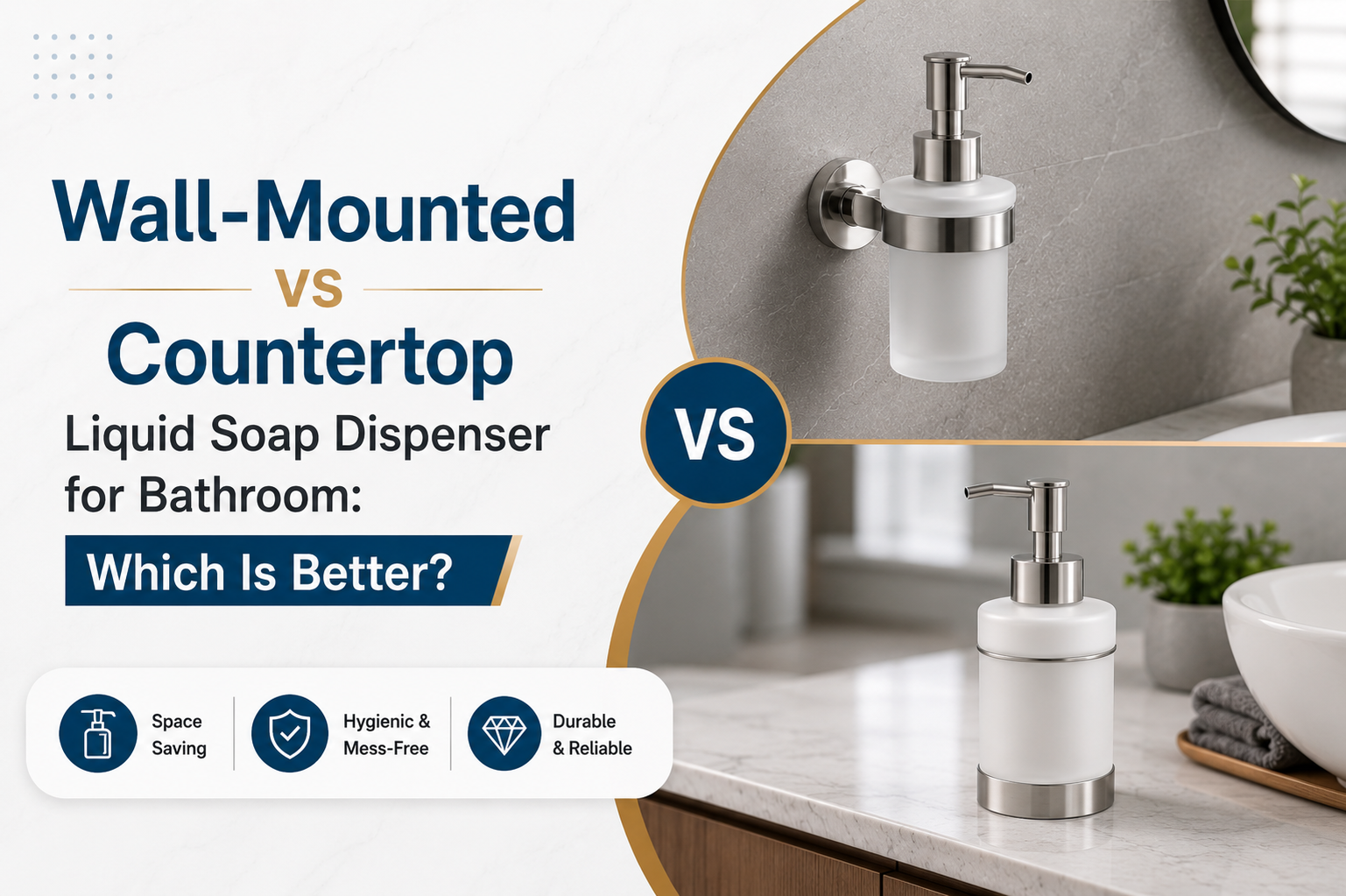
Wall-Mounted vs Countertop Liquid Soap Dispenser for Bathroom: Which Is Better?

Most people just grab whatever liquid soap dispenser for bathroom use happens to be sitting on the shelf at the store. Whatever matches the tap, or whatever’s cheapest that week. A few months later, the countertop one keeps tipping over every time someone bumps the counter, or the wall-mounted one turns out to be fixed in the wrong spot entirely. Neither is really a bad product. It’s just usually the wrong pick for that particular bathroom.

If you’re trying to work out which type actually suits your space, not just which one looks nicer online, here’s what actually matters.

What Is the Difference Between a Wall-Mounted and Countertop Liquid Soap Dispenser?

A wall-mounted liquid soap dispenser fixes directly onto the wall near the basin, freeing up counter space entirely. A countertop soap dispenser sits on the counter itself, usually refillable by unscrewing the top, and needs no drilling or installation at all. Wall-mounted ones suit busy or shared bathrooms; countertop ones suit smaller counters or rented spaces where drilling isn’t really an option.

FeatureWall-MountedCountertop
InstallationDrilling required, fixed positionNone, just place it
Counter space usedNoneSome, depending on size
StabilityCan’t tip overCan tip if bumped or knocked
RefillingTop-fill or cartridgeUnscrew and refill from top
Best forShared bathrooms, hotels, gymsVanity counters, guest bathrooms, rentals
Typical finish matchMatches other wall fittings easilyMatches vanity accessories and tray sets

Why Do Bathrooms Need a Dedicated Liquid Soap Dispenser Instead of a Bar of Soap?

A dispenser is simply more hygienic than a bar sitting in a wet dish. Bars pick up bacteria from every hand that touches them and stay damp between uses, which isn’t ideal in a household bathroom. That’s part of why it’s become such a common upgrade in family bathrooms with young kids.

There’s a practical side too. A dispenser controls how much soap actually comes out per pump, so a bottle lasts longer than a bar that ends up melting away in standing water. It also just looks tidier sitting on a counter that’s trying to stay minimal.

Which Type Suits a Small Bathroom Better?

Go wall-mounted if counter space is genuinely tight. Freeing up even a few inches of vanity makes a real difference in a small bathroom, and it stays free permanently, not just until someone sets a phone or a hairbrush down there.

Go countertop if you’re renting, if the wall near the basin is tiled in a way that makes drilling annoying, or if you’d rather keep the option to move the dispenser around whenever you feel like it.

How Do You Choose Between a Wall Mounted Liquid Soap Dispenser and a Countertop One?

A few things worth thinking through first. How many people actually use this bathroom day to day? More users usually means more chance of a countertop unit getting knocked over, so wall-mounted tends to hold up better there. Is the wall near the basin tiled or plastered? Tiled walls need proper anchors for a wall-mounted unit, and that’s a bigger job than most people expect going in.

Do you own the place or rent it? Renters generally can’t drill into tile, so countertop ends up being the safer, reversible choice. And how often does it need refilling? Countertop units are usually quicker to top up since there’s no bracket or wall plate getting in the way.

When Should You Choose a Countertop Soap Dispenser Over a Wall-Mounted One?

Pick countertop when the bathroom’s a guest space used occasionally, when you’re not planning to stay in the property long-term, or when you want something that visually matches a tray, tumbler, and soap dish already sitting there. It’s also just easier if you like rearranging your bathroom layout every so often, since nothing’s fixed down.

Can Bathroom Liquid Dispenser Manufacturers Match Your Modern Bathroom Accessories?

Yes, and this matters more than people realize until they actually see a mismatch sitting in their own bathroom. Established liquid dispenser manufacturers tend to offer the same unit across several finishes, chrome, matte black, brushed steel, so it can match existing taps, towel bars, and soap dishes instead of standing out as the one piece that doesn’t belong.

Veltrix, as one of the bathroom liquid dispenser manufacturers based in Rajkot, builds both wall-mounted and countertop dispensers across the same finish ranges used on its other modern bathroom accessories. That way a full matching set comes from one order, instead of you hunting down a dispenser separately somewhere else.

Should You Buy From Hand Soap Dispenser Manufacturers or a Generic Retailer?

Buy from a manufacturer if you actually want the thing to last and match everything else. Hand soap dispenser manufacturers can tell you exactly what the pump mechanism is made of, since cheap plastic pumps tend to jam or start leaking within a year of daily use. They can usually supply the same model again down the line too, if you need a replacement or want a second one for another bathroom.

A generic retailer sells whatever happens to be in stock that season, and finding the exact same finish six months later often just isn’t possible. Fine for a quick, cheap buy. Not great if you’re fitting out several bathrooms and want everything to actually match.

Conclusion

Whether a wall-mounted or countertop liquid soap dispenser for bathroom use suits you better really comes down to counter space, how many people use the bathroom, and whether you can drill into the wall at all. Get that part right, and the dispenser just quietly does its job for years instead of becoming another thing you have to replace.

Veltrix manufactures liquid soap dispensers from its facility in Rajkot, alongside a full range of modern bathroom accessories built to match across finishes. If you’re planning a bathroom fit-out and want fittings that’ll still match five years from now, it’s worth talking to a manufacturer directly rather than picking pieces from different sellers.

Frequently Asked Question

Q1: Are wall-mounted soap dispensers better than countertop ones? 

Not universally, they’re just suited to different bathrooms. Wall-mounted wins on stability and free counter space. Countertop wins on easy installation and flexibility, especially in rented spaces.

Q2: How often does a liquid soap dispenser need refilling? 

Depends on household size, but a standard 300 to 500ml dispenser in a two-person bathroom usually needs topping up every three to four weeks with normal daily use.

Q3: Can a wall-mounted soap dispenser be installed without drilling? 

Some adhesive-mounted options exist, but they’re less reliable over time, especially once a full bottle adds real weight. A properly anchored wall-mounted unit holds up much better long-term.

Q4: What finish options are usually available for bathroom soap dispensers? 

Chrome, matte black, and brushed steel are the most common, matching what’s typically available across other bathroom accessories like towel bars and soap dishes.

Q5: Do liquid dispenser manufacturers offer bulk orders for hotels or offices? 

Yes, most established manufacturers supply bulk orders for hospitality and commercial projects, usually with consistent finish and refill mechanisms across every unit in the order.

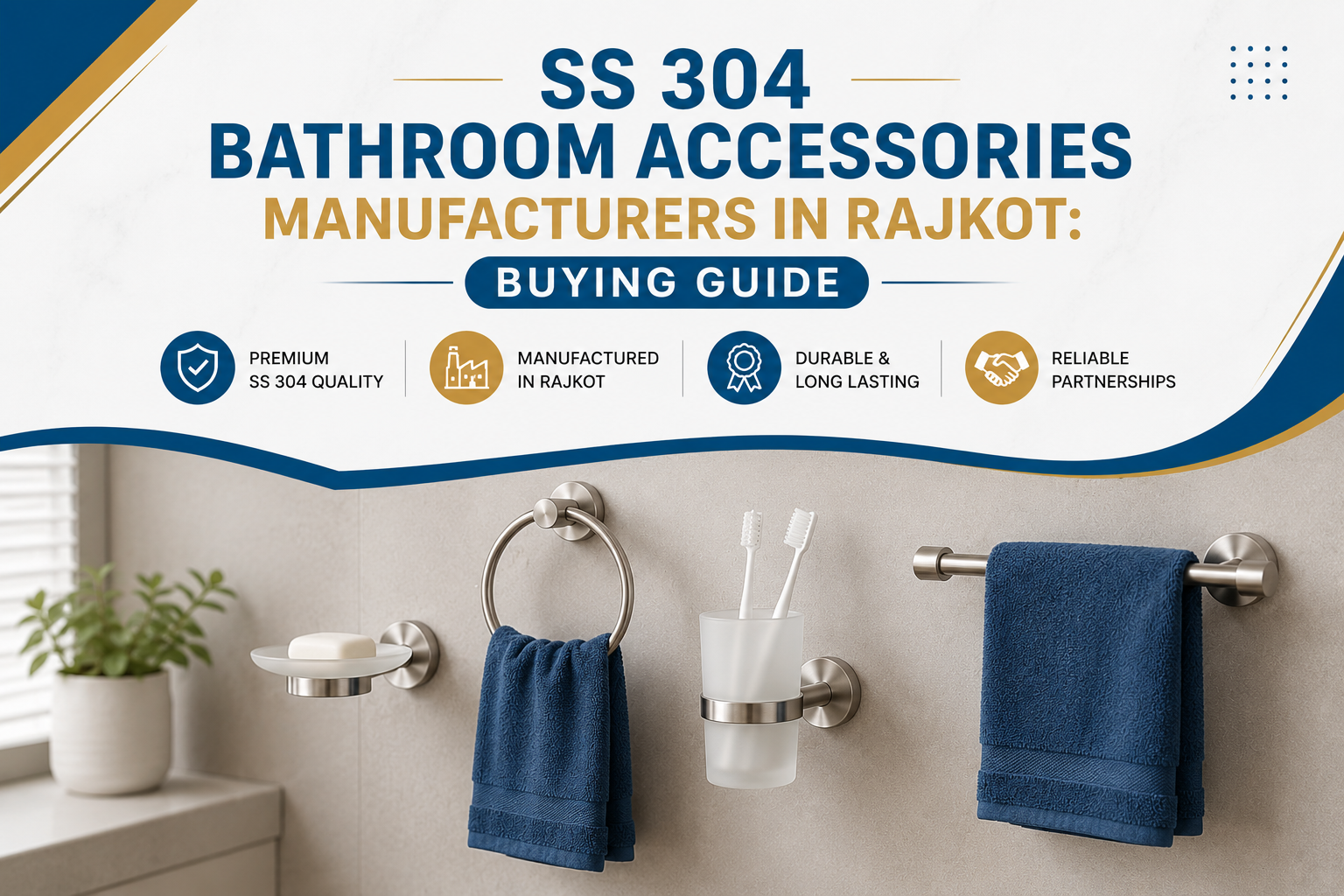
SS 304 Bathroom Accessories Manufacturers in Rajkot: Buying Guide

Ask five sellers what “stainless steel” means and you’ll get five different answers. At least two of them will be wrong. Some grades start rusting within a year in a humid bathroom, while others go a decade without a single spot of discoloration. Nine times out of ten, the difference comes down to something buyers never think to ask about upfront: the actual steel grade.

This one’s for architects, contractors, and homeowners trying to work out how SS 304 bathroom accessories manufacturers in Rajkot actually operate, why this particular grade is worth paying extra for, and how to tell a real manufacturer apart from someone just reselling stock they never touched.

What Does SS 304 Actually Mean for Bathroom Accessories?

SS 304 is a stainless steel grade made up of roughly 18% chromium and 8% nickel. That mix is what gives it strong rust and staining resistance in humid spaces like bathrooms, which is why most serious manufacturers reach for it on:

  • Soap holders and dishes
  • Towel bars and racks
  • Robe hooks and paper holders
  • Basically anything dealing with daily water contact

Cheaper alternatives looks identical, but they’re not the same thing at all. SS 202 has a lower nickel content, so it spots and dulls faster even though nobody can tell just by looking at it. Chrome-plated mild steel is worse still. There’s no real corrosion-resistant base underneath, just a thin plated layer sitting over ordinary steel.

The difference only becomes obvious after six months of actual daily use, when the weaker grade starts showing faint orange spots near the screw holes or bracket joints, usually right where water tends to sit and collect.

GradeChromium / NickelRust ResistanceTypical Use
SS 304~18% chromium, ~8% nickelHigh, holds up for years in wet areasSoap holders, towel bars, towel racks
SS 202Lower nickel contentModerate, prone to spotting over timeBudget fittings, low-moisture areas
Chrome-plated mild steelNo real chromium/nickel baseLow, plating wears and rust followsCheapest fittings, short lifespan

Why Do SS 304 Bathroom Accessories Manufacturers in Rajkot Matter for Buyers?

Rajkot’s built its name on brass and stainless steel hardware manufacturing over several decades now, and honestly, that history matters once you’re sourcing fittings in bulk. Skilled labor’s already in place here, not something that needs training up from scratch. Tooling’s been refined over years of running the same processes. Raw material supply chains stay local instead of leaning on imports.

For buyers, that history shows up in a few concrete ways. Bulk orders tend to move faster since production isn’t waiting on imported steel to clear customs. Inspecting quality before a large order is easier too, since the factory floor is right there rather than somewhere overseas. Pricing tends to be more competitive as well, simply because the SS 304 sheet and rod supply chain is already local. And there’s just a bigger pool of manufacturers to actually compare, instead of being stuck picking between one or two national suppliers.

Which Bathroom Fittings Should Always Be SS 304?

Not every accessory needs the top grade. But a handful see enough water contact that cutting corners shows up fast, sometimes within months rather than years.

Stainless steel soap dish holder sits in near-constant contact with water and soap residue, so it’s usually the first fitting to show rust if the grade’s wrong somewhere. 

Stainless steel towel rod carries repeated weight from wet towels every single day, which means the load-bearing brackets need to hold their finish under real stress, not just look shiny the day they’re installed.

304 stainless steel towel rack tends to span a wider footprint with multiple bars, so the grade has to stay consistent across every joint. One weak point in a mass-manufactured rack usually fails well before the rest of the unit does.

How Do You Verify a Bath Fitting Manufacturer Is Actually Using SS 304?

Two things worth doing before placing a large order. First, ask for a material test certificate, usually shortened to MTC. Most legitimate manufacturers hand this over without much fuss for bulk orders, and it confirms the exact composition of the steel batch that was actually used, rather than you just taking someone’s word for it.

Second, try a basic magnet test. SS 304 is only weakly magnetic, so if a strong magnet pulls hard toward the fitting, that’s usually a sign of a cheaper grade dressed up with chrome plating. Not foolproof on its own, but paired with an MTC request, it filters out most sellers who are quietly cutting corners.

When Should You Buy From Bathroom Accessories Wholesalers Instead of a Single Manufacturer?

Really depends on how big the project is.

Wholesalers make more sense when:

  • You need a mix of brands or finishes for a smaller job
  • You’d rather not juggle several manufacturer relationships at once
  • It’s a single home renovation or a smaller retail order

Going direct to a manufacturer makes more sense when:

  • You’re fitting out a hotel or a residential complex with dozens of near-identical bathrooms
  • Consistent finish across every unit actually matters
  • You want direct pricing, without a wholesaler’s margin stacked on top
  • You need someone who can answer a real question about steel grade instead of passing it along

Can Bath Accessories Manufacturers in Rajkot Handle Custom Bulk Orders?

Yes, and honestly, this is where working with an established manufacturer pays off the most. Most bath accessories manufacturers in Rajkot running their own in-house production can adjust bracket lengths and mounting points, switch finish types between chrome, matte black, or brushed steel, and handle packaging for large or export orders. A reseller just can’t do any of that, since they don’t control the manufacturing line themselves.

Take a hotel project needing 200 identical bathroom sets, for instance. That kind of order really only works well with a manufacturer who can hold the exact same finish and dimensions across every unit, rather than sourcing from three different suppliers and hoping the batches end up close enough.

Should You Choose a Bathroom Accessories Supplier Based on Price Alone?

No, and this is probably the single most common mistake buyers make. A bathroom accessories supplier quoting a price well below the market rate for “SS 304” fittings is almost always cutting something, whether that’s the steel grade itself, the finish thickness, or the wall gauge of the fitting. Sometimes all three.

A fairer way to compare suppliers is to request quotes for the exact same specification, same gauge, same grade, same finish, and treat any price that’s dramatically lower as a reason to ask more questions. Not a reason to place the order right away.

Conclusion

Getting SS 304 bathroom accessories right isn’t really about finding the shiniest fitting on a catalogue page. It comes down to verifying the steel grade before you buy, understanding why Rajkot’s manufacturing base makes sourcing genuinely easier, and knowing which fittings, a soap holder or towel bar especially, need SS 304 the most because of constant water exposure.

Veltrix manufactures SS 304 bathroom accessories out of its own facility in Rajkot, working directly with architects, contractors, and homeowners on everything from single-bathroom orders to full bulk hotel projects.

Frequently Asked Question

Q1: What is SS 304 and why is it used in bathroom accessories?

It’s a stainless steel grade, roughly 18% chromium and 8% nickel, and that combo is what keeps it from rusting or staining in a humid bathroom. Most manufacturers default to it for anything that touches water regularly, soap holders and towel bars especially.

Q2: How can I tell if a bathroom accessory is genuinely SS 304?

Honestly, just ask the manufacturer for a material test certificate. That’s the real answer. A magnet can give you a rough clue too, since SS 304 barely responds to one, but don’t rely on that alone, pair it with the certificate.

Q3: Is SS 304 better than SS 202 for bathroom fittings?

Yeah, in most cases. The higher chromium and nickel in 304 just holds up better against corrosion once things get wet. SS 202 is cheaper upfront, but you’ll start seeing rust around the screws and joints sooner than you’d like.

Q4: Do SS 304 bathroom accessories cost more than standard alternatives?

A little, somewhere in the 15 to 30% range depending on what you’re buying. But that extra cost tends to pay for itself, since you’re not replacing rusted fittings every couple of years like you would with a cheaper grade.

Q5: Why is Rajkot a preferred destination for bathroom accessories manufacturing?

Rajkot is known for its strong engineering and manufacturing industry. Many manufacturers in the city use modern production techniques, skilled workmanship, and strict quality control to produce premium stainless steel bathroom accessories.

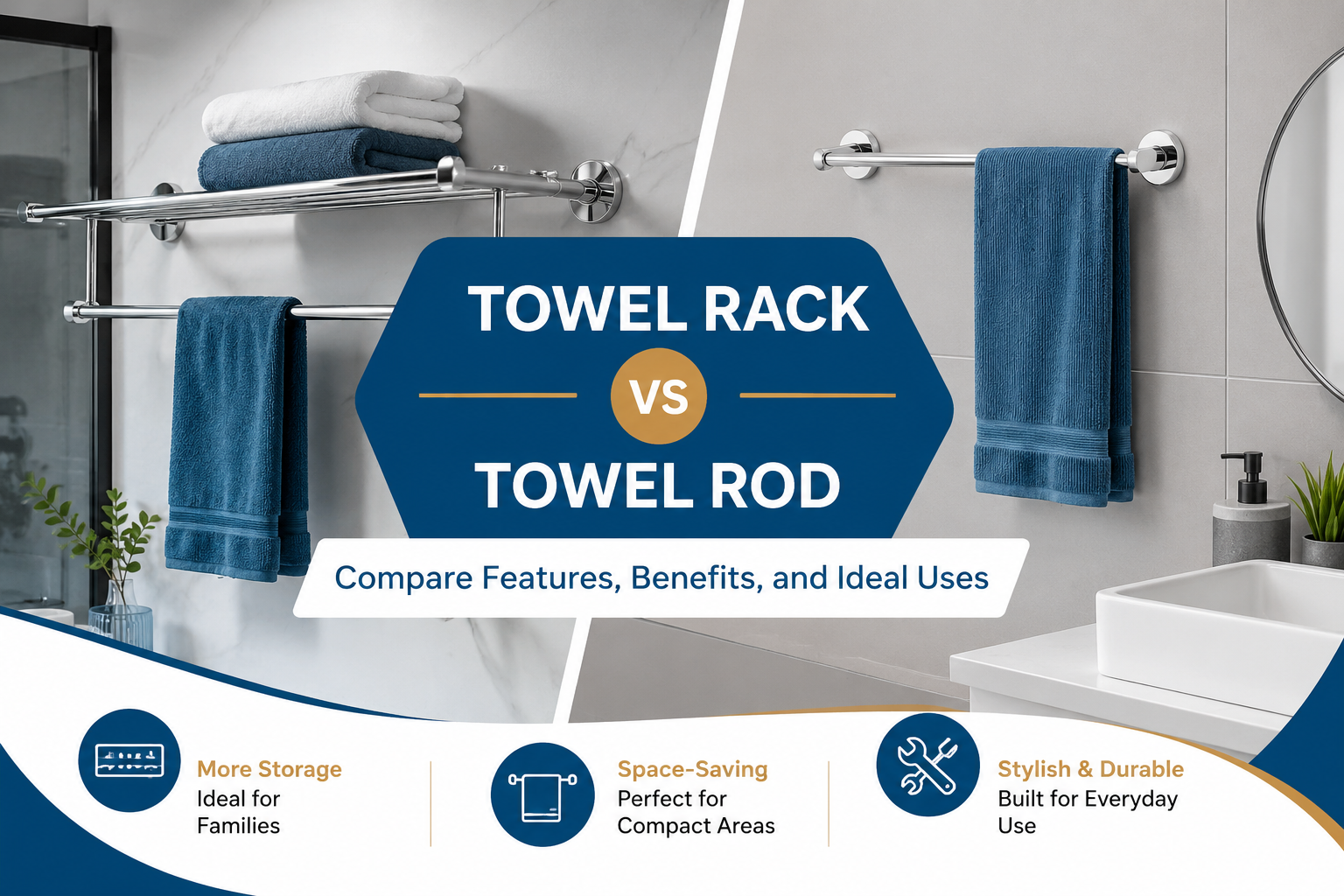
Towel Rack vs Towel Rod: Compare Features, Benefits, and Ideal Uses

Nobody thinks about towel racks until they’re standing in a showroom staring at two bars that look almost identical, trying to decide which one to buy. Feels like a throwaway decision. It’s not, though. Get it wrong and you’re looking at years of damp towels bunched onto a hook because the towel hanger you bought was never going to fit two or three people using the same bathroom every morning.

This is for anyone renovating, building from scratch, or just swapping out something rusted, and trying to figure out whether a towel rack or a towel rod is actually right for their bathroom. Most of what’s below comes from installation feedback across real residential and hospitality jobs, not a spec sheet someone typed up in an office.

What Is the Difference Between a Towel Rack and a Towel Rod?

A towel rod is one straight bar, usually held up by two end brackets, meant for a single towel to hang flat and dry properly. A towel rack has multiple bars, or sometimes a ladder-style frame, and it’s built to hold several towels at once. If your bathroom is tight on space, go rod. If more than one person’s sharing the bathroom, go rack.

FeatureTowel RodTowel Rack
Number of towels heldOneTwo or more
Wall space neededLowModerate to high
Drying speedFaster, towel hangs flatSlower if towels overlap
Best bathroom typeGuest, ensuite, minimalistFamily, shared, hotel rooms
Typical length18–24 inches24 inches and up, or ladder-style
Installation points2 brackets2–4 brackets or full frame

Which One Should You Choose for a Small Bathroom?

The rod, honestly. A bath towel rod sticks out less, takes up less wall, and matters a lot more than people expect when the bathroom door swings inward or the gap between the basin and shower is already narrow to begin with.

It dries towels quicker too, just because nothing’s bunched up against itself. But here’s the catch: if two people are sharing that bathroom every single morning, one towel rod for bathroom use won’t cut it on its own. You’ll end up with a second towel draped over the door handle, which is exactly the mess you were trying to avoid. At that point, either a slim double-bar towel rack for bathroom spaces or two rods spaced apart does the job better than cramming everything onto one bar.

Why Does a Wall-Mounted Towel Rack Matter More Than the Design Does?

Placement is honestly what makes or breaks either option day to day, more than whatever finish or design you picked. Put a towel rod too close to the shower door and it gets splashed every single time someone steps out. Put it too far away and nobody bothers walking over for it, so it ends up on the floor within a week. We’ve seen this happen more times than we can count.

A towel rack wall mounted correctly should sit within arm’s reach of wherever you actually dry off, not shoved into whatever corner had free wall space. There’s a pattern we notice on site visits: a bathroom that’s otherwise well thought out, tiles picked carefully, fittings matched, and then the towel hanger in the bathroom is clearly an afterthought, you can tell because there’s a damp towel sitting on the counter instead of on the rack six feet away.

Height matters too, though people rarely think about it upfront. Chest height for adults works for most households, somewhere around there. If kids are using the bathroom, a lower second bar tends to actually get used, instead of one mounted purely for adult reach.

How Do You Install a Bath Towel Rod or Bathroom Towel Rack Properly?

Installation isn’t hard, but it fails in the same handful of ways every time. The brackets need to hit a wall stud or use proper anchors, especially on tiled walls, because a wall-mounted towel rack loaded with wet towels is putting continuous pull on those fixing points, not a one-time load. That’s the real reason racks come loose within a year: bad fixing, not a bad rack.

After that, it’s mostly about spacing. Leave enough gap between the rack and the wall so a towel can actually hang and breathe, rather than just touching tile and staying damp all day. And if you’re mounting near a heated towel setup or underfloor heating, check the clearance guidance first. Some finishes don’t handle sustained heat the same way others do.

When Should You Use a Towel Rack for Bathroom Instead of a Towel Rod for Bathroom?

Go with a rack once more than one towel needs somewhere to hang, or the bathroom’s shared by a family, or you want hand towels kept separate from bath towels instead of stacked on top of each other. Ladder-style racks also do well in bathrooms that double as a drying spot for laundry, since they simply hold more without things overlapping.

A rod fits guest bathrooms, smaller ensuites, anywhere one towel at a time genuinely covers it. It also just looks better in a minimalist bathroom. A bulky towel hanger tends to look out of place against clean, simple fittings.

Can a Towel Rack Manufacturer in Rajkot Match International Quality?

Yes, and honestly, the local option often holds up better long-term. Rajkot’s been a brass and stainless steel manufacturing hub for decades now, so bathroom accessories manufacturers usually work with the same SS304-grade steel international brands use, minus the import markup and the long wait for a replacement part.

Veltrix, as one of the bathroom towel bar manufacturers based in the city, builds and finishes its entire range in-house, which is a big part of why finish consistency across a bulk order holds up. Say you’ve got forty identical hotel rooms to fit out: sourcing from three or four smaller vendors almost never gives you that same consistency, and towel rod manufacturers in Rajkot with in-house production tend to manage bulk timelines better for exactly that reason.

Should You Choose a Towel Rack Supplier or a Towel Rod Manufacturer Over a Hardware Store?

Go with a proper towel rack supplier or towel rod manufacturer if you actually want the fitting to last. They can tell you the exact steel grade, match the finish across the rest of your bathroom accessories, and usually replace one damaged piece without forcing you to buy the whole set over again.

A hardware store sells whatever happens to be on the shelf that week, and half the time nobody there knows what’s actually behind the chrome plating. Fine for a quick cheap fix. Not fine when you’re doing a full bathroom fit-out where every piece needs to match and hold up for a decade of daily use. This is also where working with a dedicated towel rack manufacturer pays off, since they can hold the same finish across dozens of units without you chasing five different vendors.

Conclusion

Veltrix manufactures and supplies towel racks and towel rods from Rajkot, working as a trusted towel rack supplier and one of the established bathroom towel bar manufacturers for architects, interior designers, and homeowners across India, on standard finishes as well as custom bulk orders. Planning a fit-out and wanting fittings that’ll still match in five years? Worth talking to a manufacturer directly instead of guessing at a showroom.

Frequently Asked Question

Q1: How many towel bars or rods does an average family bathroom actually need?

Two, usually. One per person for daily use, and if there are kids in the house, it helps to hang the second one a bit lower so they actually reach it instead of dumping the towel on the floor.

Q2: What’s the standard length of a bathroom towel rod?

Somewhere between 18 and 24 inches covers most folded bath towels without the ends flopping against the wall. If the bathroom’s on the wider side, some people go up to 30 inches, but honestly, once you’re past that, you’re better off with a rack.

Q3: Can a towel rack also hold a bathrobe or hand towels?

Yeah, that’s actually pretty common with the ladder-style ones. Bath towel on one bar, robe on the next, hand towels down at the bottom, and none of it ends up tangled together.

Q4: Do towel racks and rods need to match the finish of other bathroom fittings?

Not strictly, but it shows when they don’t. Put a chrome rod next to a matte black tap and soap dispenser, and that mismatch is usually the first thing people notice, even if they can’t say why the bathroom feels off.

Q5: How much weight can a wall-mounted towel rack safely hold?

More than people worry about, as long as it’s anchored into a wall stud and not just stuck to the tile. Soaked towels aren’t really the problem here; a weak fixing point is what actually gives way.

Modern Bathroom Decor Accessories for Minimalist Interiors

Take a look at most bathrooms renovated a decade ago, and you’ll spot the same problem: a yellowed plastic soap dish, a towel hook that’s come loose from the wall, and a dispenser that doesn’t match anything else in the room. Modern bathroom accessories solve this, and honestly, they do it without requiring you to spend a fortune or end up with a bathroom that feels too precious to actually use.

This guide is for anyone fitting out or renovating a minimalist bathroom and trying to figure out which modern bathroom decor accessories are actually worth buying, what finishes hold the aesthetic together, and what to avoid.

What Makes a Bathroom Accessory Work in a Minimalist Interior?

A minimalist bathroom is built on three things: clean lines, consistent finishes, and no visual clutter. An accessory earns its place in that space only if it does one of the following:

  • Serves a clear daily function
  • Sits flush or close to the wall so it does not interrupt the visual flow
  • Matches the finish of every other fitting in the room

Anything that does not meet at least two of those three criteria adds noise to a space that is supposed to be quiet. That is the filter to run every purchase through before you commit to it.

Why Do Modern Bathrooms Need the Right Accessories?

Here’s something we see constantly: a bathroom with beautiful tiles and a decent vanity that still somehow looks unfinished. Nine times out of ten, it’s the accessories dragging the whole thing down.

A rose-gold tap paired with a plastic soap dish just looks like nobody planned it, even if the tiling cost a fortune. Glass and stainless steel also hold up far better against humidity than plastic, which tends to warp or discolour within a couple of years in Indian bathrooms. They’re easier to wipe clean too, since smooth surfaces don’t trap soap scum the way textured plastic does. And frankly, good fittings just don’t need replacing every time you repaint, which saves money you’d otherwise spend redoing the same small stuff.

Which Modern Bathroom Decor Accessories Actually Matter?

A minimalist bathroom needs a wall-mounted soap dish, toothbrush holder, paper holder, towel rod, robe hook, and liquid dispenser at minimum. Each should be wall-mounted, finish-matched, and chosen from the same design series so the space reads as intentional rather than assembled piece by piece. These are the modern bathroom decor accessories worth prioritising first, before anything decorative.

Glass soap dish: Drains water better than plastic and won’t stain over time. Because it’s transparent (or lightly tinted), it makes a small bathroom feel less cluttered instead of adding to the mess.

Glass toothbrush holder: Pairs naturally with a glass soap dish so the counter looks like it belongs together. It’s also harder to ignore when it needs cleaning; plastic tends to hide grime that glass just won’t.

Liquid soap dispenser: More hygienic than a bar sitting in a dish, obviously. But we’ve also noticed it’s become one of the most-requested swaps in family bathrooms with young kids, probably because bars of soap and toddlers don’t mix well.

Bathroom towel rack: This one’s really about storage more than style. In a tight bathroom, a rack placed well keeps towels off the floor and off the back-of-door hook, which is usually the first thing that makes a bathroom look messy.

Bathroom towel bar: Works better than a full rack when you just need one or two towels within reach of the shower and don’t have wall space to spare. A lot of our clients use a bar near the basin and a full rack closer to the shower.

Which Finish Works Best in a Minimalist Bathroom?

Snippet answer: Matte black and chrome are the two finishes that suit minimalist bathrooms best. Matte black gives strong, graphic contrast against white or grey tiles. Chrome keeps the space light and clean without drawing attention to itself.

Here is how to choose between them:

Your Bathroom PaletteRecommended Finish
White tiles, white walls, neutral groutChrome or Matte Black
Grey tiles, concrete effect, dark groutMatte Black
Warm white, beige, or off-white tonesChrome or Rose Gold
Wooden vanity, warm neutral tonesGold or Rose Gold

The most important thing is not which finish you choose, but that you use it consistently. Every fitting in the bathroom—paper holder, soap dish, toothbrush holder, towel rod, robe hook, and dispenser should be in the same finish. One gold fitting among chrome ones breaks the whole visual rule minimalism runs on.

Which Veltrix Series Suits a Minimalist Bathroom?

Veltrix, one of the established bathroom accessories manufacturers in India, makes its full range across six design series. For minimalist interiors specifically, two series stand out.

FUSION is the most natural fit for a minimalist bathroom. The bracket design is clean and angular, available in chrome and matte black, which are the two finishes minimalist interiors call for most often.

ARIES works particularly well in compact minimalist bathrooms. The design is sharp and structured, also available in chrome and matte black, and the proportions suit smaller wall spaces without looking undersized.

For warmer minimalist interiors, IRIS and LUIZ in rose gold or gold add warmth without adding clutter.

Here is a quick reference across the full range:

Your PriorityBest SeriesAvailable FinishesWhy It Works
Best value, clean lookELITEChromeSimple design, no unnecessary detailing
Warm or traditional feelRUSTICChromeTextured finish suits natural material interiors
Maximum finish choiceIRIS or LUIZChrome, Gold, Rose GoldThree finish options in one series
Bold contrast lookFUSIONChrome, Black MattAngular design built for dark, modern spaces
Small bathroom, tight wall spaceARIESChrome, Black MattCompact proportions without looking undersized
Premium or hospitality projectLUIZChrome, Gold, Rose GoldMost refined metalwork across the full range

Should You Buy From Bathroom Accessories Manufacturers in India or Import?

For most Indian homes and projects, going local just makes more sense practically. Bathroom accessories manufacturers in India understand things imported catalogues don’t account for, like local water hardness, humidity, and how installation actually works on Indian wall types. All of that affects how long a finish actually lasts.

Imported pieces can look great in photos, sure. But try getting a replacement part or filing a warranty claim six months later, and the appeal fades fast. There are cases where an imported finish genuinely fits a client’s brief, we won’t pretend otherwise, but for everyday renovations, sourcing locally usually wins on both support and turnaround.

What Makes Veltrix a Reliable Bathroom Accessories Manufacturer?

Veltrix is among the bathroom accessories manufacturers in Rajkot with a facility that’s been running in Rajkot, Gujarat for over two decades. The full product range is built and finished in-house, which means finish consistency, material quality, and delivery timelines are all managed under one roof, not outsourced across three different vendors.

As a bathroom accessories supplier working with homeowners, interior designers, architects, and contractors, Veltrix supplies both individual pieces for single bathrooms and bulk orders for large residential or hospitality projects. Being one of the few bathroom accessories manufacturers in Rajkot with all six series and four finishes produced at one facility means a complete matching set for any bathroom style can be sourced from a single conversation with the team, rather than five separate ones.

Frequently Asked Questions

Q1: What material is best for modern bathroom accessories?

SS304 stainless steel and toughened glass are your safest bets. Steel resists rust and handles humidity well, while glass keeps things looking light and is genuinely easy to keep spotless.

Q2: Are glass bathroom accessories safe and durable?

Yes, as long as it’s toughened or tempered glass. It’s built to resist chipping and cracking under normal daily use, which is why it’s become standard in modern fittings.

Q3: How do I match accessories to my bathroom’s style?

Pick one finish—matte black, brushed steel, chrome, or another option—and stick to it across every piece, including taps. Mixing finishes is the most common reason a bathroom ends up looking unplanned.

Q4: How often should bathroom accessories be replaced?

Quality stainless steel or glass accessories can easily last 8–10 years with normal use. Replace them sooner only if you notice rust, cracks, or they no longer match your renovated bathroom.

Q5: Is it better to buy accessories as a set or pick them individually?

Buying a matching set keeps the finish and proportions consistent, making it much easier to achieve a cohesive bathroom design than sourcing individual pieces from different sellers.

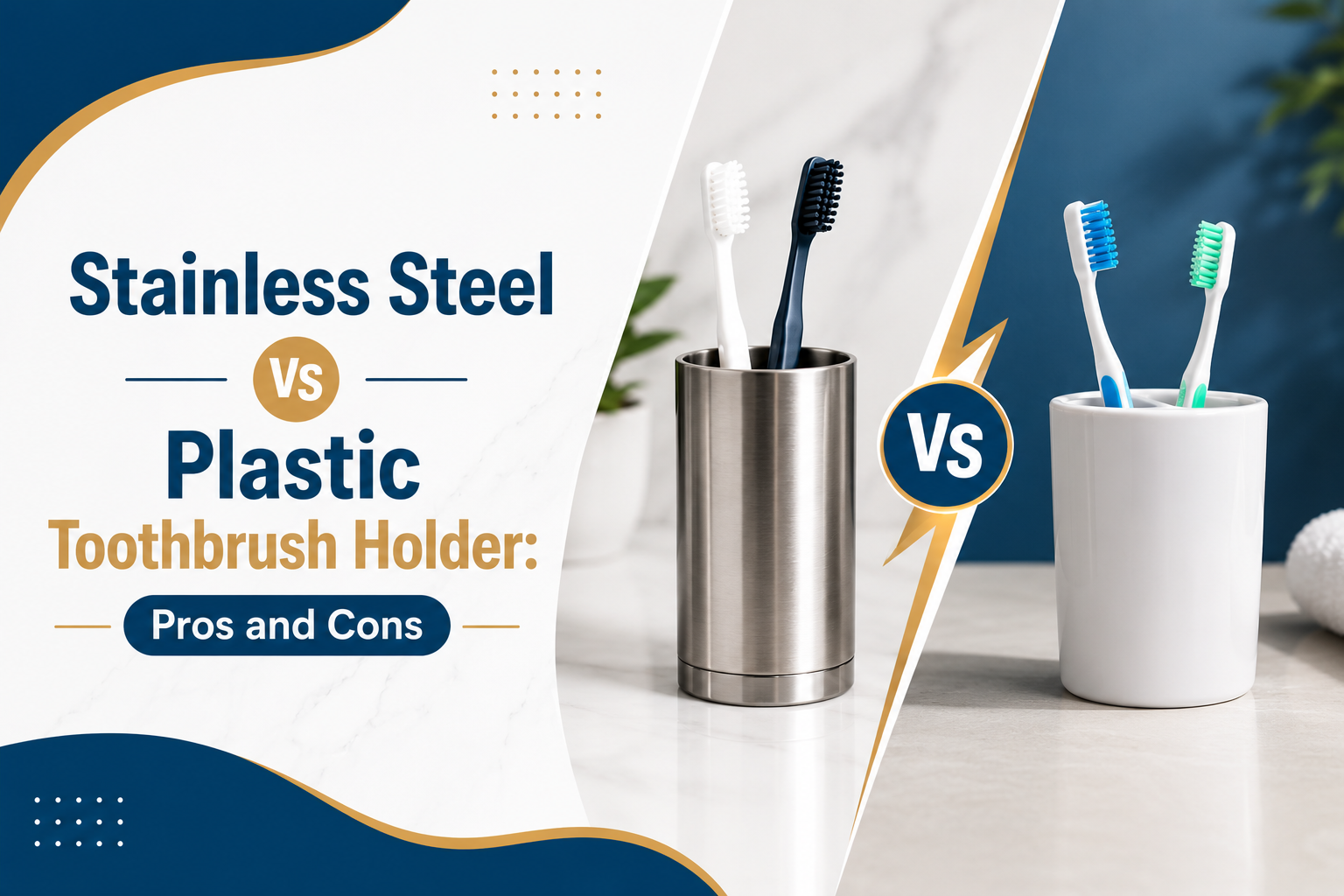
Stainless Steel vs Plastic Toothbrush Holder: Pros and Cons

Walk into any hardware store or scroll through any bathroom accessories page and you will find two broad categories of toothbrush holders: metal ones that look sharp and cost more, and plastic ones that are cheap and available everywhere. The question most people actually want answered is simple: is the price difference worth it, or does plastic do the job just as well?

This post gives you the honest answer, based on how each material actually performs in a real bathroom, day after day.

What Is the Main Difference Between a Stainless Steel and Plastic Toothbrush Holder? 

A stainless steel toothbrush holder is made from corrosion-resistant metal that handles humidity well, holds its finish for years, and stays hygienic with minimal cleaning. A plastic holder is lighter and cheaper but tends to discolour, crack, and develop a soap residue film over time.

The difference is not just about looks. It’s about how each material responds to the one thing a bathroom produces constantly: moisture. A toothbrush holder in a humid bathroom is exposed to steam, splashing water, and daily handling every single day of the year. What it’s made from determines how it holds up after month six, year two, and year five.

What Are the Pros of a Stainless Steel Toothbrush Holder?

Stainless steel toothbrush holders resist rust, don’t absorb bacteria, stay easy to wipe clean, and maintain their finish in humid bathrooms far longer than plastic. They also look more premium, which makes them a natural fit alongside modern bathroom accessories.

Here’s what stainless steel does well:

  • Rust resistance: Good quality stainless steel, particularly 304-grade, doesn’t corrode in humid bathrooms even after years of use
  • Hygiene: The surface doesn’t develop the faint biofilm that plastic tends to build up over time
  • Durability: It won’t crack, warp, or yellow, which are the three most common ways plastic holders fail
  • Finish options: Available in chrome, matte black, gold, and rose gold, so it matches bathroom fittings naturally
  • Weight and stability: Heavier than plastic, which means a wall-mounted steel holder stays firmly in place rather than wobbling

The main trade-off is cost. Stainless steel holders cost more than plastic ones upfront, but they typically don’t need replacing for years, which makes the maths work out over time.

What Are the Cons of a Stainless Steel Toothbrush Holder?

No material is perfect. A few honest downsides worth knowing:

  • It costs more than plastic at the point of purchase
  • Poor quality metal finishes, usually zinc alloy disguised as stainless steel, can corrode badly and look worse than plastic after a year
  • Heavier weight means installation needs to be done properly, with proper anchoring into the wall, not just surface adhesive

The last point matters. A wall-mounted stainless steel holder that’s properly drilled and anchored will last years. One stuck up with adhesive tape will eventually pull away from the tile, often taking a chunk of paint or grout with it.

What Are the Pros of a Plastic Toothbrush Holder?

Plastic has genuine advantages, and it’s worth being fair about them:

  • Low cost: The most affordable option available, often a fraction of the price of metal
  • Lightweight: Easier to install, and some designs work with adhesive mounting that avoids drilling
  • Wide availability: Found in nearly every price range and style
  • Good for temporary use: If you’re renting, fitting out a guest bathroom temporarily, or need a short-term solution, plastic makes sense

For a guest bathroom that sees occasional use, a budget plastic holder does the job without any real complaint.

What Are the Cons of a Plastic Toothbrush Holder?

This is where the honest answer gets important. Plastic works fine initially, but it has some consistent failure patterns in bathrooms:

  • Discolouration: White and light-coloured plastic yellows over time, especially in bathrooms with direct sunlight or regular humidity
  • Cracking: Repeated temperature changes and humidity cycles cause plastic to become brittle and crack, usually at the mounting points or drainage holes
  • Surface buildup: Plastic develops a faint film from soap residue and water minerals that becomes harder to clean over time
  • Short lifespan: Most plastic holders need replacing within two to three years in a regularly used bathroom
  • Limited finish options: Plastic rarely matches the look of chrome taps, steel towel rods, or other metal bathroom accessories

Which Is More Hygienic: Stainless Steel or Plastic?

Stainless steel is more hygienic in the long run. Its non-porous surface doesn’t absorb moisture, bacteria, or soap residue. Plastic develops micro-scratches over time from cleaning, and those scratches trap bacteria that a surface wipe won’t fully remove.

Both materials can be kept clean with regular wiping. The difference shows up over months of use. Stainless steel wipes clean and stays clean. Plastic, especially once it develops surface scratches, holds onto residue even after cleaning.

For a bathroom toothbrush holder used by the whole family every day, this matters more than it might seem.

Is a Glass Toothbrush Holder a Better Alternative?

A glass toothbrush holder sits between steel and plastic in terms of performance. It’s non-porous like steel, so it doesn’t absorb bacteria, and it looks premium. But it’s more fragile than either option and needs careful handling, especially in bathrooms used by children.

Veltrix also manufactures glass toothbrush holders for bathrooms where the look of glass complements the interior better than metal. The glass component is tempered, paired with a metal bracket in chrome, gold, rose gold, or matte black finish.

For most family bathrooms, stainless steel is the more practical daily-use choice. For a master bathroom or guest bathroom with less traffic, a glass toothbrush holder adds a refined visual detail that metal doesn’t quite replicate.

Which Veltrix Toothbrush Holder Suits Your Bathroom?

Veltrix makes wall-mounted toothbrush holders across six design series, all in metal with durable electroplated finishes. Every series is also available as a glass toothbrush holder for bathrooms where glass suits the interior better than metal.

The simplest way to narrow it down is to start with your existing bathroom finish, your taps, towel rod, and shower fittings, and match from there.

FinishSeries AvailableStyle It Works With
ChromeELITE, RUSTIC, IRIS, FUSION, ARIES, LUIZAny bathroom, the most versatile option
GoldIRIS, LUIZClassic, warm, or luxury interiors
Rose GoldIRIS, LUIZModern, contemporary, or glam bathrooms
Black MattFUSION, ARIESMinimalist, dark-toned, or bold spaces

Chrome is available across all six series, which makes it the easiest finish to work with. If your bathroom fittings are already chrome, any series will sit naturally alongside them without looking like an afterthought.

Gold and rose gold are available in IRIS and LUIZ only. Both series are built for bathrooms that lean warmer or more premium, think wooden vanities, warm-toned tiles, or a deliberate hotel-style finish.

Black Matt is available in FUSION and ARIES. If your bathroom has dark grout, concrete-effect tiles, or a matte black mixer tap, either of these series will tie the look together cleanly. ARIES works particularly well in smaller, more compact bathrooms where a sharp, minimal look is the goal.

Not sure which series within a finish to go with? The design difference between series is mostly about the shape and detailing of the bracket. ELITE and RUSTIC are simpler and more understated. LUIZ and IRIS have a slightly more refined, premium feel to the metalwork. Either way, the underlying quality and build is consistent across all six.

When Should You Replace a Toothbrush Holder?

Most people replace theirs only when something breaks. A few signs that say it’s time before that point:

  • The finish is peeling, flaking, or rusting
  • The holder wobbles or has pulled slightly from the wall
  • Plastic has yellowed or cracked around the mounting points
  • You’ve renovated and the existing holder no longer matches the new fittings

Replacing a plastic holder after two to three years is common. A well-made stainless steel holder, properly installed, should still look fine after a decade.

What Makes Veltrix a Reliable Toothbrush Holder Manufacturer?

Veltrix is a bathroom accessories manufacturer based in Rajkot, Gujarat, producing toothbrush holders alongside soap dishes, paper holders, towel rods, towel racks, robe hooks, and liquid dispensers. Every holder goes through durability and load testing before it leaves the facility.

As a toothbrush holder supplier working with homeowners, architects, interior designers, and hospitality projects across India, Veltrix supplies both individual pieces and bulk orders with consistent quality across every unit.

Conclusion: Which One Is Actually Worth Buying?

For a bathroom you use every day, stainless steel wins on every measure that matters over time: durability, hygiene, finish quality, and how it looks alongside the rest of your bathroom fittings. Plastic is cheaper upfront, but most people replace it within a few years, which closes that cost gap faster than expected.

If you want something that still looks good in year five without thinking about it, a wall-mounted stainless steel toothbrush holder from Veltrix is the straightforward choice. Browse the full range or get in touch with the team in Rajkot for personal orders or bulk project supply.

Frequently Asked Questions

Q1: Is stainless steel or plastic better for a toothbrush holder in a humid bathroom?

Stainless steel performs significantly better in humid conditions. It doesn’t rust, crack, or yellow, and its surface stays hygienic longer than plastic, which develops biofilm in micro-scratches over time.

Q2: How long does a plastic toothbrush holder last?

In a regularly used bathroom, most plastic holders show visible yellowing, cracking, or surface buildup within two to three years. Stainless steel holders, properly installed, typically last a decade or more.

Q3: Does Veltrix make glass toothbrush holders?

Yes. Veltrix manufactures both metal and glass toothbrush holders. The glass versions use tempered glass with a metal bracket in chrome, gold, rose gold, or matte black.

Q4: What series does Veltrix offer for toothbrush holders?

Veltrix offers six series: ELITE, RUSTIC, IRIS, FUSION, ARIES, and LUIZ, each available in specific finishes including Chrome, Gold, Rose Gold, and Black Matt.

Q5: Are Veltrix toothbrush holders wall-mounted?

Yes. All Veltrix toothbrush holders are wall-mounted, which keeps brushes off wet surfaces, frees up counter space, and is easier to clean around than a countertop stand.

Q6: Can I order toothbrush holders in bulk from Veltrix?

Yes. Veltrix supplies bulk orders for residential projects, hotels, and commercial spaces with consistent finish quality across large quantities. Contact the team in Rajkot for project pricing.

Benefits of Using a Wall-Mounted Glass Soap Dish

There’s a small, specific kind of annoyance that comes from a soggy bar of soap sitting in a puddle of its own water. It dissolves faster than it should, leaves a ring on the counter, and somehow never looks clean no matter how new it is. Most people blame the soap. The actual problem is usually the dish it’s sitting in.

A wall-mounted glass soap dish solves this in a way plastic and ceramic dishes never quite manage. It’s a small fitting, but it changes how long your soap lasts, how your bathroom counter looks, and how often you’re scrubbing water stains off a ledge. Here’s what actually makes glass the better choice, and what to look for when picking one.

What Is a Wall-Mounted Glass Soap Dish? 

A wall-mounted glass soap dish is a two-part bathroom fitting: a glass tray that holds the soap, set into a metal bracket fixed to the wall. Unlike countertop dishes, it sits off the sink ledge entirely, keeping water away from surfaces and freeing up counter space.

The design is simple by nature. The glass piece is what touches the soap, since glass doesn’t absorb moisture, soap residue, or odour the way some other materials do. The bracket, usually chrome, gold, rose gold, or matte black, is what holds everything to the wall and is what gives the fitting its visual finish.

Why Does Soap Last Longer in a Glass Dish? 

Soap dissolves fastest when it sits in standing water. A wall-mounted glass dish, especially one with drainage in the design, lets water run off instead of pooling under the bar. This single change is the biggest factor in how long a bar of soap actually lasts.

Think about how a bar of soap behaves in two scenarios. Left on a flat ledge in its own puddle, it softens, sticks to the surface, and breaks down within days. Set in a properly designed glass dish, off the counter and angled to drain, it dries between uses and lasts noticeably longer. The difference isn’t the soap, it’s where it’s sitting.

How Does a Glass Soap Dish Compare to Plastic or Ceramic? 

Glass resists staining, doesn’t absorb soap residue, and won’t crack from heat or daily impact the way ceramic can. Plastic discolours over time and often develops a slightly tacky surface from soap buildup. Glass stays clear and easy to wipe clean for years.

A quick side-by-side:

  • Plastic: Cheapest option, but tends to yellow, scratch, and hold onto a faint soap smell over time
  • Ceramic: Looks elegant initially, but chips easily and can crack if a bar is dropped into it repeatedly
  • Glass: Doesn’t stain, doesn’t absorb odour, and a quick wipe is usually all it needs to look new again

If you’ve ever noticed a soap dish that looks permanently dingy no matter how often it’s cleaned, that’s usually a material problem, not a cleaning problem.

Why Choose Wall-Mounted Over a Countertop Soap Dish? 

A wall-mounted soap dish keeps water off your counter entirely, frees up sink-side space, and is easier to clean around since there’s no base collecting moisture. Countertop dishes are simpler to set up but almost always leave a water ring behind.

This matters more than people expect in small bathrooms. A countertop dish takes up real estate next to the tap, the same space you need for a toothbrush holder or a soap dispenser. Mounting the soap dish on the wall, just above the basin or inside the shower area, clears that space completely and keeps the counter genuinely dry.

Which Finish Should You Choose for a Glass Soap Dish? 

Chrome suits most modern bathroom accessories and works well with existing silver fittings. Matte black pairs strongly with minimalist, grey, or concrete-toned bathrooms. Gold and rose gold suit warmer, more premium interiors with vintage or glam touches.

A few things to keep in mind when matching the bracket finish:

  • Chrome — the most versatile, pairs with almost any tile or fixture colour
  • Matte Black — strong contrast, best with white, grey, or concrete-style bathrooms
  • Gold — adds warmth, suits classic or vintage-inspired interiors
  • Rose Gold — softer and more contemporary, works well in modern glam bathrooms

The glass tray itself stays consistent across finishes. What changes is the bracket, so picking the right one really comes down to matching your existing taps, towel rod, and toothbrush holder.

Can a Glass Soap Dish Handle a Humid Bathroom Long-Term?

Yes, when the glass is tempered and the bracket is properly rust-resistant. Tempered glass doesn’t absorb moisture or develop the cloudy buildup that lower-quality materials show after a year or two of daily humidity exposure.

A few things determine how well a glass soap dish actually holds up:

  • Tempered glass is stronger and more resistant to cracking than standard glass
  • A rust-resistant bracket (good quality chrome or coated metal) won’t corrode from constant moisture
  • Proper sealing at the wall mount stops water from creeping behind the fitting

A soap dish that’s cheaply made anywhere along this chain will start showing wear within a year. One built properly, glass and bracket alike, holds its finish for years.

How Do You Install a Wall-Mounted Glass Soap Dish?

Installation is simpler than most people expect:

  • Mark the position above the basin or inside the shower area, ideally where water can run off naturally
  • Drill into the wall stud or use anchor plugs rated for the fitting’s weight
  • Fix the metal bracket using the screws provided, avoid mixing in random hardware that may rust
  • Slide or seat the glass tray into the bracket once it’s secured
  • Apply a thin line of waterproof sealant around the base to stop moisture seeping behind the wall plate

Most glass soap dish kits, including Veltrix’s, come with everything needed for a straightforward DIY install, no plumber required.

What Makes Veltrix a Trusted Glass Soap Dish Manufacturer?

Veltrix manufactures its full glass soap dish range at its facility in Rajkot, Gujarat, using tempered glass paired with rust-resistant metal brackets built to handle daily use in humid bathrooms. The range spans six design series, each available in specific finishes, so there’s a match for nearly every bathroom style:

SeriesAvailable Finishes
ELITEChrome
RUSTICChrome
IRISChrome / Gold / Rose Gold
FUSIONChrome / Black Matt
ARIESChrome / Black Matt
LUIZChrome / Gold / Rose Gold

As a glass soap dish holder manufacturer, every piece goes through finish durability checks before it ships, whether it’s a single unit for a home bathroom or a bulk order for a hotel project.

A Small Fitting That Makes a Real Difference

A wall-mounted glass soap dish isn’t a dramatic renovation decision, but it’s one of those small fittings that quietly improves your bathroom every single day. Your soap lasts longer, your counter stays dry, and the bathroom looks more finished without much effort.

If you’re choosing between materials or finishes, Veltrix‘s glass soap dish range, manufactured in Rajkot, offers tempered glass with chrome, gold, rose gold, and matte black bracket options across six design series. Browse the collection or reach out to the team directly for personal or bulk orders.

Frequently Asked Questions

Q1: Why does soap last longer in a glass soap dish?

Glass doesn’t trap moisture against the soap the way other materials can, and a properly designed dish drains water away instead of letting it pool. This keeps the bar from softening and dissolving prematurely.

Q2: Is a glass soap dish better than a ceramic one?

Generally yes. Glass resists staining and chipping better than ceramic, and it doesn’t absorb soap residue or odour the way ceramic surfaces sometimes do over time.

Q3: Can I install a wall-mounted glass soap dish myself?

Yes. Most kits, including Veltrix’s, come with wall-mounting hardware and don’t require a plumber. A drill and basic anchor plugs are usually all you need.

Q4: What finishes does Veltrix offer for glass soap dishes?

Veltrix offers glass soap dishes in Chrome, Gold, Rose Gold, and Black Matt, across six design series: ELITE, RUSTIC, IRIS, FUSION, ARIES, and LUIZ.

Q5: Does a glass soap dish need special maintenance?

No. A soft cloth and mild cleaner is enough to keep both the glass and the metal bracket looking new, with no special care required.

Q6: Where are Veltrix glass soap dishes manufactured?

All Veltrix glass soap dishes are manufactured in Rajkot, Gujarat, using tempered glass and rust-resistant metal brackets built for daily use in humid bathrooms.

Bathroom Decor Accessories Checklist for Renovation Projects

Most bathroom renovation guides spend pages on tiles, plumbing, and waterproofing, then squeeze accessories into one paragraph at the end. That’s backwards. Tiles and plumbing get the budget, but accessories are what you actually touch every single day, and they’re usually the last thing people think about, which means they end up rushed, mismatched, or skipped entirely.

This checklist flips that order. If you’re planning a renovation and want a clear list of bathroom decor accessories to budget for, room by room, this covers everything from the obvious to the easy-to-forget.

What Bathroom Decor Accessories Do You Actually Need? 

A complete bathroom needs a paper holder, soap dish, toothbrush holder, towel rod or rack, robe hook, napkin ring, and liquid dispenser at minimum. Each serves a specific daily function, and skipping one usually means improvising with something less hygienic or less convenient.

Here’s the full list, with what each one actually does:

  • Paper holder — keeps the roll dry, off the floor, and within reach
  • Soap dish — drains water so bar soap doesn’t turn to mush
  • Toothbrush holder — keeps brushes upright and away from the wet counter
  • Towel rod or towel rack — lets towels dry properly instead of staying damp on a hook
  • Robe hook — a small fitting that solves a surprisingly common “where do I hang this” problem
  • Napkin ring — small but functional for hand towels in guest bathrooms
  • Liquid dispenser — neater and more hygienic than bottles sitting on the ledge

Skipping any of these doesn’t save much money. It just means you’ll improvise with something worse, like a wet bar of soap sitting directly on a ledge, or a toothbrush balanced against the mirror.

Why Do Bathroom Accessories Matter as Much as Fixtures? 

Fixtures like basins and showers define the bathroom’s structure, but accessories define how it feels and functions day to day. A beautifully tiled bathroom with mismatched, low-quality accessories still looks unfinished. Matching, well-placed accessories pull the whole design together.

This is the part most renovation checklists miss. You can spend lakhs on a premium wash basin and shower panel, and the bathroom will still look unfinished if the soap dish is a leftover plastic one from the old setup. Accessories are the detailing that makes a renovation look intentional rather than assembled in pieces.

How Do You Choose Bathroom Accessories for a Small Bathroom? 

For a small bathroom, prioritise wall-mounted accessories over freestanding ones. A wall-mounted soap dish, toothbrush holder, and towel rod free up counter and floor space, which matters more in compact bathrooms than in larger ones.

If your bathroom is on the smaller side, a few adjustments make a real difference:

  • Choose wall-mounted over countertop or freestanding wherever possible
  • Pick a soap dish + toothbrush holder combo instead of two separate fittings, it saves wall space and looks cleaner
  • Go for a towel rod instead of a bulky towel rack if floor space is tight
  • Keep finishes consistent so the small space doesn’t feel visually busy

Small bathrooms punish clutter more than large ones. Every accessory you add should either save space or simplify a daily task, ideally both.

Which Bathroom Decor Items Should You Prioritise First?

Start with the accessories you use daily: paper holder, soap dish, and toothbrush holder. These get used multiple times a day and have the biggest impact on hygiene and convenience. Decorative add-ons like napkin rings can follow once the essentials are sorted.

If your renovation budget is tight and you need to phase purchases, here’s a sensible order:

  1. Paper holder — non-negotiable, day one priority
  2. Soap dish — same urgency, used constantly
  3. Toothbrush holder — used twice daily, easy to overlook until it’s missing
  4. Towel rod or rack — needed as soon as the bathroom is usable
  5. Robe hook — useful, but can wait a week if needed
  6. Napkin ring and liquid dispenser — nice finishing touches, lowest urgency

Veltrix Bathroom Accessories Checklist — What to Budget For

Here’s the complete renovation checklist mapped to Veltrix’s actual product range, so you know exactly what to source and where:

AccessoryPurposeAvailable As
Paper HolderHolds and protects the toilet rollWall-mounted, multiple finishes
Soap DishDrains water, keeps soap usable longerSingle, Double, or Glass
Toothbrush HolderKeeps brushes upright and dryStandard or Glass
Soap Dish + Toothbrush HolderCombo unit for space-saving installsWall-mounted combo
Towel RodLets towels hang flat and dry fullyWall-mounted bar
Towel RackHolds multiple towels, better for family bathroomsWall-mounted multi-bar
Robe HookSingle-point hanging for robes or towelsWall-mounted hook
Napkin RingHolds hand towels or napkinsWall-mounted ring
Liquid DispenserNeater storage for soap or sanitiserWall-mounted or counter

Should All Your Bathroom Accessories Match in Finish and Style? 

Yes, ideally. Mismatched finishes, like a chrome towel rod next to a gold soap dish, create visual noise even in an otherwise well-designed bathroom. Sourcing accessories from one manufacturer in a consistent finish is the simplest way to avoid this.

This is the single most common mistake in DIY renovations. People buy the paper holder from one shop, the towel rod from another, and the soap dish off a marketplace app, and the finishes never quite match. Sourcing your full set of modern bathroom accessories from one manufacturer solves this automatically, since every piece is designed to sit in the same finish family.

Can You Get a Complete Bathroom Accessories Set from One Supplier?

Yes. Veltrix, a bathroom accessories manufacturer in Rajkot, supplies all the core categories, paper holders, soap dishes, toothbrush holders, towel rods, towel racks, robe hooks, napkin rings, and liquid dispensers, as matching sets in consistent finishes.

This matters more for renovation projects than people expect. Coordinating delivery timelines, finish consistency, and quality checks across five separate vendors adds real friction to a renovation. Working with one manufacturer for the full accessories list removes that entirely.

When Should You Order Bathroom Accessories During a Renovation?

Timing accessories wrong is a common renovation mistake. Order too early and finishes might get damaged during tiling work. Order too late and the bathroom sits unusable even after the major work is done.

  • Order accessories once tile selection is finalised — finish and colour decisions are easier when you know what the tiles look like
  • Have accessories on-site before final fitting begins — installers need them in hand to mark drill points accurately
  • Install accessories after tiling and waterproofing are fully cured — drilling into fresh tile work risks cracking or compromising the seal

A good rule: order accessories two to three weeks before your expected handover date, so they arrive with buffer time for any reordering.

How Do You Source Bathroom Accessories for Bulk or Project Use?

If you’re a contractor, architect, or builder managing multiple bathrooms, sourcing accessories one piece at a time doesn’t scale. This is where working with a wholesale bathroom accessories supplier matters.

Veltrix supplies bulk orders for residential projects, hotels, and commercial spaces, with consistent finish quality across large quantities. For project-based work, this means:

  • One point of contact instead of juggling multiple vendors
  • Predictable lead times across the full accessories list
  • Volume pricing that single-unit retail simply doesn’t offer
  • Quality consistency across every unit in a large order, which matters when fitting out twenty identical bathrooms in a hotel project

What Makes Veltrix a Reliable Bathroom Accessories Manufacturer in Rajkot?

Veltrix has been manufacturing bathroom accessories for over two decades, built around a straightforward principle: source good raw material, finish it properly, and stand behind the product. The full catalogue spans soap dishes, toothbrush holders, paper holders, towel rods, towel racks, robe hooks, napkin rings, and liquid dispensers, manufactured at the company’s facility in Rajkot, Gujarat.

For renovation projects specifically, working with a single manufacturer for the entire accessories checklist means fewer delivery delays, consistent finish across every fitting, and one team to call if anything needs adjusting after installation.

Build Your Bathroom Decor Accessories Checklist Early

Accessories are easy to leave for the last week of a renovation, and that’s exactly when they get rushed. Building your bathroom decor accessories checklist early, alongside your tile and fixture decisions, means the finishing touches actually finish the room instead of feeling like an afterthought.

Whether you’re renovating one bathroom or sourcing for an entire project, Veltrix supplies the complete accessories range, paper holders, soap dishes, toothbrush holders, towel rods, robe hooks, and more, in matching finishes from a single manufacturer in Rajkot. Get in touch to plan your full checklist before your next renovation begins.

Frequently Asked Questions

Q1: What bathroom accessories should be on every renovation checklist?

At minimum: a paper holder, soap dish, toothbrush holder, towel rod or rack, and robe hook. These cover daily essential functions and are the items most noticeable when missing or mismatched.

Q2: What are the best bathroom accessories for a small bathroom?

Wall-mounted accessories work best for small bathrooms. A soap dish + toothbrush holder combo and a towel rod, instead of a full rack, save valuable wall and floor space without compromising function.

Q3: When should bathroom accessories be ordered during a renovation?

Order accessories once your tile and finish selections are confirmed, ideally two to three weeks before the expected handover date. Install them only after tiling and waterproofing have fully cured.

Q4: Can I buy a full set of matching bathroom accessories from one manufacturer?

Yes. Veltrix manufactures the complete range, paper holders, soap dishes, toothbrush holders, towel rods, towel racks, robe hooks, napkin rings, and liquid dispensers, in matching finishes from its Rajkot facility.

Q5: Does Veltrix supply bathroom accessories in bulk for projects?

Yes. As a wholesale bathroom accessories supplier, Veltrix works with contractors, architects, and hospitality projects that need consistent quality across large-volume orders.

Q6: Why do bathroom accessories need to match in finish?

Mismatched finishes create visual clutter, even in a well-tiled bathroom. A consistent finish across all accessories gives the space a more finished, intentional look, and is easiest to achieve by sourcing from one manufacturer.

Toothbrush Holder Buying Guide for Homeowners

Nobody really thinks about their toothbrush holder until it starts looking grimy, or the suction cup gives up and falls off the tile for the third time. It costs less than almost anything else in your bathroom, yet you touch it twice a day, every day. That alone makes it worth getting right.

If you’re renovating, fitting out a new bathroom, or just tired of toothbrushes lying flat on the counter, this guide covers what actually matters when picking a toothbrush holder: material, mounting style, finish, and how it fits with the rest of your bathroom accessories.

What Really Matters in a Toothbrush Holder

A good toothbrush holder keeps brushes upright and off wet surfaces, drains water so bristles dry properly, resists rust and corrosion in humid bathrooms, and mounts securely without taking up counter space.

That’s really it. Everything else, finish, design, brand sits on top of these basics. A toothbrush left lying on a wet counter picks up bacteria faster than one stored upright and ventilated. That’s not a marketing claim, it’s just how moisture and airflow work.

Why Does a Wall-Mounted Toothbrush Holder Make More Sense Than a Countertop One?

A wall hanging toothbrush holder frees up counter space, keeps brushes away from sink splashes and tap water, and is easier to clean around. Countertop holders are simpler to install but collect water at the base and take up valuable sink-side space.

Most Indian bathrooms,especially in apartments, don’t have generous counter space to begin with. Once you add a soap dispenser, a tumbler, and daily essentials, a countertop toothbrush stand becomes one more thing competing for room.

This is why wall-mounted designs have become the default choice in modern bathrooms:

  • They sit above splash level, so brushes stay drier
  • They free up the entire counter for actual counter use
  • They’re easier to wipe down since there’s no base collecting water
  • They match better with matching towel rods, soap dishes, and napkin rings mounted at the same height

At Veltrix, every toothbrush holder we manufacture is wall-mounted for exactly these reasons.

How Do You Choose the Right Material for a Bathroom Toothbrush Stand?

Stainless steel and chrome-plated metal hold up best in humid Indian bathrooms. Plastic is cheap but cracks and discolours within a year. Ceramic looks elegant but breaks if dropped. Glass needs frequent cleaning to avoid water spots.

Here’s how each material actually performs over time:

  • Chrome-plated metal: Durable and easy to wipe clean. Resists rust as long as the base metal underneath is good quality. The most practical choice for everyday bathrooms.
  • Stainless steel: Long-lasting, hygienic, doesn’t discolour. The usual choice for hotels and bathrooms that see heavy daily use.
  • Plastic: Cheap upfront, but tends to yellow, crack, or warp once it’s been through enough humidity cycles.
  • Ceramic and glass: Look elegant on a shelf, but they’re a poor match for bathrooms with kids, or anyone moving fast in the morning.

If you want something that still looks new five years from now, metal is the safer bet.

Which Veltrix Toothbrush Holder Suits Your Bathroom Style?

Veltrix makes toothbrush holders across six design series, each in specific finishes. Here’s the full range, so you can match it to what’s already in your bathroom:

SeriesAvailable FinishesBest Suited For
ELITEChromeSimple, classic bathrooms on a budget
RUSTICChromeWarm, textured, traditional interiors
IRISChrome / Gold / Rose GoldPremium bathrooms wanting a luxe finish
FUSIONChrome / Black MattModern homes with bold, dark accents
ARIESChrome / Black MattCompact, contemporary bathrooms
LUIZChrome / Gold / Rose GoldHigh-end, hotel-style bathroom design

A simple way to decide: if your taps, shower set, and towel rod are chrome, stay with chrome. ELITE, RUSTIC, ARIES, and FUSION all offer it. If your fittings lean warmer, with gold or rose gold accents, IRIS and LUIZ are built for that palette. And if your bathroom has dark tiles or a matte black mixer, FUSION or ARIES in Black Matt will tie the look together.

Should a Toothbrush Holder Match Your Other Bathroom Accessories?

Yes. Mixing finishes, like a chrome toothbrush holder next to a gold soap dish, creates visual clutter, especially in small bathrooms. Matching finishes across your toothbrush holder, soap holder, napkin holder, and towel rod gives the whole bathroom a cleaner, more finished look.

This is something homeowners often notice only after the bathroom is fully fitted, when one piece suddenly looks out of place. Veltrix manufactures matching sets, soap holders, napkin holders, towel rods, and toothbrush holders, across the same six series and finishes. That makes it easy to keep everything consistent without sourcing from five different suppliers.

Can a Toothbrush Holder Help With Bathroom Hygiene?

Yes, more than most people realise. A toothbrush left in a closed cup or lying on a wet counter holds onto moisture, and moisture is exactly what bacteria need to grow. A few habits make a real difference:

  • Pick a holder with proper drainage or an open design, not a closed cup
  • Wipe the holder itself clean weekly with mild soap and water
  • Keep it away from directly above the toilet, where flush spray can reach it
  • Replace toothbrushes every three months, regardless of how clean the holder stays

A well-positioned, wall-mounted holder away from the toilet and sink splash zone takes care of most of this on its own.

When Should You Replace a Toothbrush Holder?

A few signs tell you it’s time:

  • The finish is peeling, flaking, or showing rust spots
  • The mounting has loosened and the holder wobbles
  • Water collects inside instead of draining out
  • You’ve renovated and the old holder no longer matches your new fittings

Replacing it isn’t expensive, and a fresh, well-matched holder genuinely changes how finished a bathroom feels.

How Do You Install a Wall-Mounted Toothbrush Holder Properly?

  • Drill into a wall stud, or use anchor plugs rated for the holder’s weight
  • Use stainless steel screws, not the cheap zinc ones that come bundled with budget kits
  • Mount it at a height that’s easy to reach but above the sink’s splash level
  • Run a thin line of waterproof sealant around the base plate so moisture can’t get in behind it

Installation matters as much as the product itself. Even a good holder will work loose over time if it’s mounted into hollow tile without proper anchoring.

What Makes Veltrix a Reliable Toothbrush Holder Manufacturer?

Veltrix is a bathroom accessories manufacturer and supplier based in Rajkot, producing toothbrush holders alongside paper holders, soap dishes, napkin rings, towel rods, and robe hooks, all designed to work together as complete sets.

Every toothbrush holder goes through durability and load testing before it leaves the facility, whether it’s headed to one homeowner’s bathroom or a bulk order for a hotel project. As a bathroom accessories bulk supplier, Veltrix works directly with architects, interior designers, and contractors who need consistent quality across large quantities, not just a handful of pieces.

Picking the Right Toothbrush Holder Doesn’t Have to Be Complicated

A toothbrush holder is small, but it’s one of the few bathroom fittings you touch every morning and every night. Getting the material, mounting, and finish right means you stop thinking about it, which is really the whole point.

Whether you’re drawn to the simplicity of ELITE, the warmth of IRIS in Rose Gold, or the contrast of FUSION in Black Matt, Veltrix‘s toothbrush holder range is built to match the rest of your bathroom without compromise. Browse the full collection, or get in touch with the team in Rajkot for personal or bulk orders.

Frequently Asked Questions

What is the best material for a toothbrush holder in a humid bathroom?

Chrome-plated metal or stainless steel performs best in humid conditions. Both resist rust and hold their finish far longer than plastic or ceramic.

Are wall-mounted toothbrush holders better than countertop stands?

For most bathrooms, yes. Wall-mounted holders save counter space, keep brushes away from sink splashes, and are easier to clean around, especially in compact Indian bathrooms.

Does Veltrix manufacture toothbrush holders in different finishes?

Yes. Veltrix offers toothbrush holders across six series, ELITE, RUSTIC, IRIS, FUSION, ARIES, and LUIZ, in Chrome, Gold, Rose Gold, and Black Matt finishes.

Can I get matching bathroom accessories along with a toothbrush holder?

Yes. Veltrix supplies matching soap holders, napkin holders, towel rods, and robe hooks in the same series and finish, so your full bathroom set looks consistent.

Does Veltrix supply toothbrush holders in bulk for hotels or projects?

Yes. As a bathroom accessories bulk supplier, Veltrix works with architects, contractors, and hospitality projects that need large-quantity orders with consistent finish and quality.

How often should a toothbrush holder be cleaned?

At least once a week, with mild soap and water, to keep bacteria from building up. A holder with good drainage helps too, since it won’t trap standing water.

WhatsApp Us Get Quote